
TL;DR

Get everyday helpers delivered free with Prime
- Fast, free delivery on millions of items
- Prime Video, Amazon Music and more included
- Member-only deals all year
The multi-institutional NATIVE-ID project will study how proteins begin to aggregate, a process linked to several neurodegenerative diseases. Stowers Institute researcher Randal Halfmann’s lab will receive about $4.1 million over two years to measure aggregation across 50,000 proteins in yeast, generating data intended to support AI predictions. The project’s early focus is frontotemporal lobar degeneration; its ability to predict disease or guide treatment remains unproven.
A new multi-institutional research project will collect large-scale data on how proteins begin to clump together, with the goal of training artificial intelligence to predict early protein dysfunction linked to neurodegenerative disease. The effort, called NATIVE-ID, is part of the Advanced Research Projects Agency for Health’s BIOGAMI program; Stowers Institute investigator Randal Halfmann’s lab is slated to receive about $4.1 million over two years for its work.
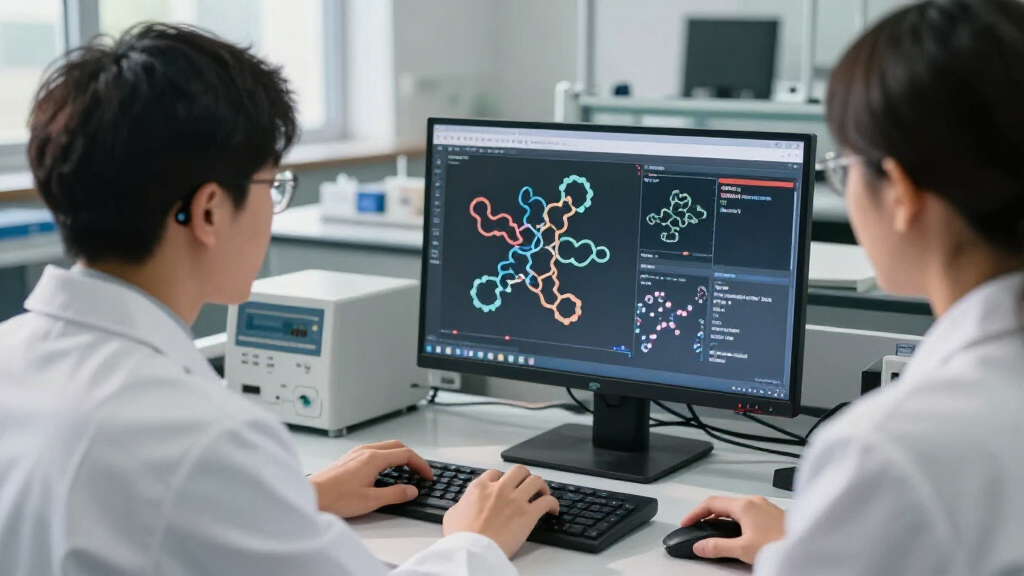
Halfmann’s team plans to test how changes in amino-acid sequences affect whether proteins remain dispersed or aggregate. It will use Distributed Amphifluoric FRET (DAmFRET), a method developed by the lab that measures protein self-assembly inside individual living cells. The experiments will express proteins in yeast under varied conditions intended to mimic changes that occur as human cells age.
The lab expects to examine 50,000 proteins across more than one million samples and produce more than 10 billion measurements of aggregation. These are projected research outputs, not results already obtained. The project is designed to supply data for AI models dealing with intrinsically disordered proteins, which can shift among multiple shapes rather than maintaining one stable structure.
The broader project is led by the Innovative Genomics Institute at the University of California, Berkeley, and includes researchers from several universities and research organizations. The team will initially focus on frontotemporal lobar degeneration (FTLD), which shares genetic and biological features with ALS, while aiming to develop methods relevant to other diseases involving protein misfolding.
Building Data for Early Predictions
Many AI systems have advanced the prediction of stable protein structures, but intrinsically disordered proteins pose a different challenge: their changing shapes and interactions can be difficult to infer from sequence alone. The project’s central contribution is a planned dataset linking protein sequences to measured aggregation behavior at scale. If useful patterns can be learned from those measurements, researchers could gain a way to identify protein interactions that warrant further study before damage is readily detectable.
Halfmann has said better estimates of disease probability and onset age could eventually help people seek preventive or early-stage treatments, or join clinical trials. That is a potential benefit, not an outcome demonstrated by this project. The work is currently focused on basic research and model development; it does not announce a diagnostic test or treatment.
As an affiliate, we earn on qualifying purchases.
From Pilot Studies to 50,000 Proteins
Proteins associated with Alzheimer’s, Parkinson’s, ALS and Huntington’s can change shape and form aggregates linked to cell damage. The project targets an earlier stage: how such behavior starts and whether it can be predicted from the underlying sequence and cellular conditions. Roughly one-third of proteins lack a stable structure, according to the source report, making them particularly challenging targets for conventional structure-prediction approaches.
Halfmann’s lab previously studied disease-related protein behavior in yeast and reported that those experiments could inform understanding of behavior in human cells. In 2023, the lab experimentally determined the initiating structure in amyloid formation associated with Huntington’s disease. Halfmann described earlier work on polyglutamine proteins and TDP-43, associated with Huntington’s, ALS and FTLD, as pilot studies for the larger effort. The new undertaking expands that work from hundreds of sequences to a planned 50,000.
NATIVE-ID combines the yeast experiments with partner teams’ capabilities, including human neurons in which model predictions can ultimately be tested. That comparison matters because a result in yeast alone would not establish that the same prediction applies in human cells.
“If we can better predict the probabilities and onset ages of disease, it could allow many more people to seek preventive or early-stage treatments or enroll in clinical trials.”
— Randal Halfmann, Stowers Institute investigator
As an affiliate, we earn on qualifying purchases.
Predictions Still Need Human Testing
The project has announced its aims and planned scale, but it has not reported measurements or AI predictions from the new work. It remains unclear how accurately models trained on the planned data will predict aggregation, whether those predictions will hold in human neurons, and whether they can identify changes early enough to matter clinically.
The source report does not provide a full project-wide budget, a detailed timetable for milestones, or a schedule for releasing data and models. It also does not establish that predicting aggregation will translate into predicting who will develop a disease, when symptoms will begin, or which intervention might help. Those questions require further validation and clinical research.
As an affiliate, we earn on qualifying purchases.
Testing Models Against Human Neurons
Halfmann’s lab is expected to generate the planned yeast-based measurements over its two-year award period. Other NATIVE-ID collaborators will contribute complementary work, including human-neuron systems for testing whether model predictions extend beyond yeast. The project’s early disease focus is FTLD, with the team aiming to assess whether approaches can later apply to other disorders involving protein misfolding.
Key milestones to watch are the production and analysis of the dataset, publication or release of model predictions, and independent tests in human-relevant cells. The project has not announced dates for those milestones. Until results are reported and validated, its proposed value for early detection, prevention or treatment remains a research goal.
FRET protein interaction measurement
As an affiliate, we earn on qualifying purchases.
As an affiliate, we earn on qualifying purchases.
Key Questions
What is the NATIVE-ID project?
NATIVE-ID is a multi-institutional research effort aiming to understand and predict protein aggregation associated with neurodegenerative disease. It is part of ARPA-H’s BIOGAMI program and is led by the Innovative Genomics Institute at UC Berkeley.
What will Halfmann’s lab do?
The Stowers Institute lab plans to use DAmFRET in yeast cells to measure how 50,000 proteins aggregate under varied conditions. The team expects to generate more than 10 billion measurements; these are planned outputs, not completed results.
Which disease will the project study first?
The group will initially focus on frontotemporal lobar degeneration (FTLD), which shares genetic and biological features with ALS. The broader aim is to develop approaches relevant to other diseases involving protein misfolding.
Does the project provide a test or treatment?
No. The announcement describes research to collect data and train AI models. It does not report a diagnostic test, a treatment, or evidence that the planned predictions will improve patient outcomes.
Source: rss
Halloween Picks
halloween
As an affiliate, we earn on qualifying purchases.