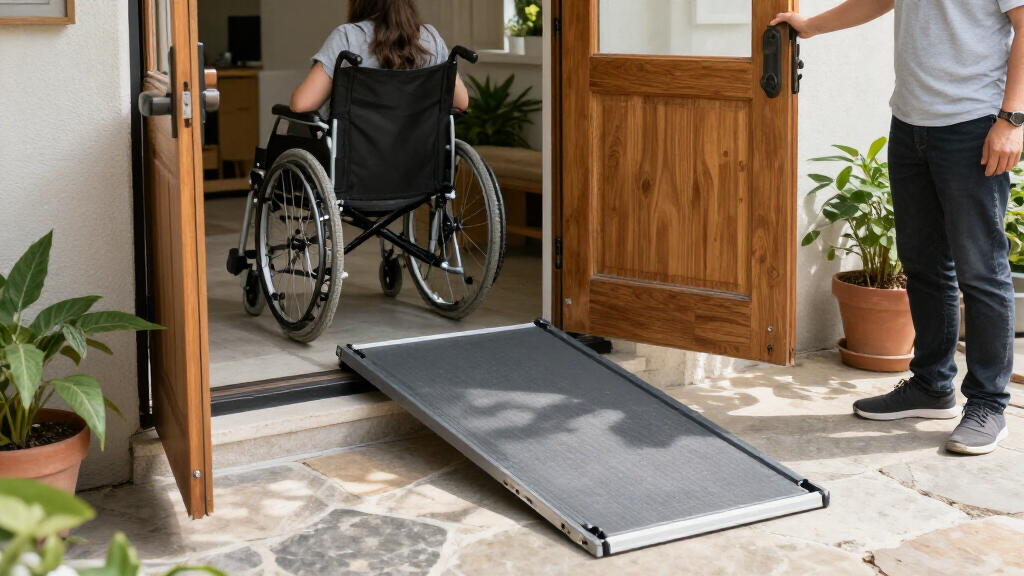
For most buyers comparing folding threshold ramps for wheelchairs, I’d start with the VEVOR 4FT Portable Aluminum Folding Wheelchair Ramp: its longer span offers a gentler approach than compact two-foot ramps. The FACHNUO 2-Foot is a more portable choice for modest rises, while the Pyle 4-Inch Rubber Threshold Ramp suits a fixed, grippy doorway setup better than a foldable aluminum ramp. The main tradeoff is between portability and a shallower slope, with doorway fit, rise height, and surface grip also shaping the decision. Read on for how the nine options compare and which ramp fits your setup.

Get everyday helpers delivered free with Prime
- Fast, free delivery on millions of items
- Prime Video, Amazon Music and more included
- Member-only deals all year
Complete the kit


Key Takeaways
- Ramp length changes the approach angle: The four- and six-foot aluminum models provide more run than the two-foot options, which can matter when a short ramp feels steep.
- Folding portability and doorway fit are different priorities: Portable aluminum ramps are easier to store or carry, while the Nuvium and Pyle options focus on threshold-height access rather than a long approach.
- Capacity claims are not interchangeable: Rocspire lists an 800 lb capacity and one two-foot ramp lists 600 lb; buyers should compare the stated limit with the combined load of user, chair, and accessories.
- Modular and detachable designs suit fixed layouts: The ROBLOCK two-pack offers a different setup approach from single-piece folding ramps, but requires buyers to check how its pieces fit their threshold.
- There is no single best surface for every doorway: Aluminum folding ramps emphasize portability, while Pyle’s rubber surface favors a non-slip threshold setup; floor type and weather exposure can affect the choice.
| VEVOR 4FT Portable Aluminum Folding Wheelchair Ramp |  | Best Overall for Mid-Height Steps | Material: Aluminum alloy | Length: 4 feet | Weight capacity: 800 lb | VIEW LATEST PRICE | See Our Full Breakdown |
| FACHNUO 2-Foot Portable Aluminum Wheelchair Ramp |  | Best Lightweight Portable Pick | Material: Aluminum | Unfolded size: 24 × 29.2 × 2 in | Folded size: 24 × 13.2 × 3.2 in | VIEW LATEST PRICE | See Our Full Breakdown |
| Nuvium 4 Inch Threshold Ramp for Doorways and Steps |  | Best for Wide or Heavy Mobility Devices | Material: Aluminum alloy | Dimensions: 16.8 × 31.5 × 4 in | Weight: 12.5 lb | VIEW LATEST PRICE | See Our Full Breakdown |
| Rocspire 3-Foot Folding Aluminum Wheelchair Ramp, 800 lb Capacity |  | Best Mid-Length Folding Option | Unfolded dimensions: 36 × 29 × 2 in | Folded dimensions: 36 × 14.5 × 2.8 in | Weight: 14 lb | VIEW LATEST PRICE | See Our Full Breakdown |
| VNN 6-Foot Portable Aluminum Wheelchair Ramp |  | Best for High Steps | Length: 6 ft | Dimensions: 72 × 29.2 × 2 in | Weight: 35.5 lb | VIEW LATEST PRICE | See Our Full Breakdown |
| ROBLOCK 3-Inch Rise Detachable Modular Wheelchair Ramp (2-Pack) |  | Best for Adjustable Threshold Fit | Material: Eco-friendly plastic | Rise height: 3 inches | Slope angle: 9 degrees | VIEW LATEST PRICE | See Our Full Breakdown |
| Rocspire 2FT Portable Folding Aluminum Wheelchair Ramp |  | Best Portable Folding Pick | Material: Aluminum with non-slip rubber | Unfolded dimensions: 24 × 29 × 2 inches | Folded dimensions: 24 × 14 × 2.8 inches | VIEW LATEST PRICE | See Our Full Breakdown |
| 2-Foot Folding Aluminum Wheelchair Ramp, 600 lb Capacity |  | Best for Visibility at Small Doorways | Length: 2 feet | Material: Aluminum alloy | Load capacity: 600 lbs | VIEW LATEST PRICE | See Our Full Breakdown |
| Pyle 4-Inch Rubber Threshold Ramp – Portable Non-Slip Wheelchair Ramp for Indoor/Outdoor Use |  | Best Heavy-Duty Fixed Threshold Ramp | Material: Rubber | Rise height: 4 inches | Dimensions: 35.4 × 24 × 4 inches | VIEW LATEST PRICE | See Our Full Breakdown |
| folding threshold ramps for wheelchair | Material | Weight | Load capacity | Dimensions |
|---|---|---|---|---|
| VEVOR 4FT Portable Aluminum Fo | Aluminum alloy | — | — | — |
| FACHNUO 2-Foot Portable Alumin | Aluminum | 10.9 lb | 800 lb | — |
| Nuvium 4 Inch Threshold Ramp f | Aluminum alloy | 12.5 lb | 1,100 lb | 16.8 × 31.5 × 4 in |
| Rocspire 3-Foot Folding Alumin | Aluminum with stainless steel hinges | 14 lb | 800 lb | — |
| VNN 6-Foot Portable Aluminum W | Aluminum | 35.5 lb | 800 lb | 72 × 29.2 × 2 in |
| ROBLOCK 3-Inch Rise Detachable | Eco-friendly plastic | — | 3,000 lbs | 31.5 × 18.11 × 2.99 inches |
| Rocspire 2FT Portable Folding | Aluminum with non-slip rubber | 11.9 lbs | 800 lbs | — |
| 2-Foot Folding Aluminum Wheelc | Aluminum alloy | 12.9 lbs | 600 lbs | 25.59 × 15.75 × 3.94 inches |
| Pyle 4-Inch Rubber Threshold R | Rubber | 33 lbs | — | 35.4 × 24 × 4 inches |
More Details on Our Top Picks
VEVOR 4FT Portable Aluminum Folding Wheelchair Ramp
The VEVOR 4-foot ramp is my strongest all-around pick here for a 4–8-inch rise: its length suits taller steps than the FACHNUO 2-foot ramp, while its 800-pound capacity and folding carry-handle design keep it practical to move and store. The grooved aluminum and coated double surface, raised side baffles, and reflective strips address traction and visibility, useful at an entry used in changing light. At 22.8 pounds, though, it is substantially heavier than the FACHNUO, so frequent carrying is less appealing. Its 4-foot length also does not make it suitable for every doorway: the entry needs room for the ramp and a flush landing, and the product notes some flex-related settling. Choose it for compatible steps, not as a universal threshold solution.
Pros:- 800-pound capacity accommodates heavier combined chair and user loads within the stated limit.
- Double non-slip surface, raised side baffles, and reflective strips support traction and visibility.
- Folding design and integrated handle make storage and carrying possible for one person.
- Four-foot length is suited to higher rises than the FACHNUO 2-foot model.
Cons:- At 22.8 pounds, it is heavier to carry than the 10.9-pound FACHNUO.
- Some flex-related sinking and rebound during use are described as normal.
- Requires flush placement and a compatible 4–8-inch rise, which may limit doorway fit.
Best for: Wheelchair users who need a portable ramp for a 4–8-inch step and want higher load capacity with side baffles.
Not ideal for: People who need a lightweight ramp for frequent carrying, or whose entry height falls outside 4–8 inches or lacks room for flush placement.
- Material:Aluminum alloy
- Length:4 feet
- Weight capacity:800 lb
- Product weight:22.8 lb
- Unfolded dimensions:47.8 × 29.3 × 2.3 in
- Folded dimensions:47.8 × 14.65 × 3.35 in
- Suitable height range:4–8 in
- Model number:HXZDPD48
Our verdict“Choose the VEVOR if your step is 4–8 inches high and you want a folding ramp with safety features and an 800-pound capacity.”
FACHNUO 2-Foot Portable Aluminum Wheelchair Ramp
At 10.9 pounds, the FACHNUO is the easiest folding option in this group to carry regularly, making it a practical choice for someone who moves a ramp between entrances or stores it after each use. Its 24-inch length is a better match for a modest step than the VEVOR 4-foot ramp, but that compact form comes with a firm limit: wheelchair use is recommended only for step heights up to 4 inches, even though the adjustment range is listed as 2–6 inches. Guide rails, a textured surface, and reflective strips add useful cues; the 800-pound capacity is also strong for this size. Before buying, check the chair’s wheelbase against the 27-inch maximum and verify that the extension plate will not obstruct a door or track.
Pros:- Weighs 10.9 pounds, making it easier to carry than the VEVOR 4-foot ramp.
- Textured surface, guide rails, and reflective strips provide traction and visual guidance.
- Folds with a built-in handle for compact storage and transport.
- 800-pound stated load capacity and corrosion-resistant stainless steel hinge.
Cons:- Wheelchair use is recommended only up to a 4-inch step despite the listed 2–6-inch adjustment range.
- Wheelchair wheelbase must not exceed 27 inches.
- Extension plate may interfere with hinged doors or sliding-door tracks.
Best for: Wheelchair users who need a light, frequently carried ramp for a step no higher than 4 inches and have a wheelbase within 27 inches.
Not ideal for: People facing steps above 4 inches for wheelchair access, chairs with wheelbases over 27 inches, or entries where the extension plate blocks a door or sliding track.
- Material:Aluminum
- Unfolded size:24 × 29.2 × 2 in
- Folded size:24 × 13.2 × 3.2 in
- Weight:10.9 lb
- Load capacity:800 lb
- Recommended adjustment range:2–6 in
- Recommended maximum step height for wheelchair access:4 in
- Maximum wheelbase:27 in
- Model:FT-WR01B-2FT-30
Our verdict“Pick the FACHNUO for a low step and regular carrying, provided your wheelchair fits its wheelbase limit and the doorway clears the extension plate.”
Nuvium 4 Inch Threshold Ramp for Doorways and Steps
The Nuvium differs from the folding carry ramps here: it is a modular threshold ramp with width adjustment, not a hinged ramp that folds for transport. That makes it a better fit for a doorway where wheel spacing varies or a wider chair needs a broad approach. Its width can be set from 15.75 to 31.5 inches, and the 1,100-pound capacity is the highest listed among these five products. Textured strips and an anti-slip surface support grip, while aluminum construction suits indoor or outdoor placement. The tradeoff is a fixed 4-inch height and assembly; unlike the FACHNUO or VEVOR, it is not presented as a quick-fold option to carry between locations. Buyers should match the height to the actual threshold before choosing it.
Pros:- Adjustable width from 15.75 to 31.5 inches accommodates varied wheel spacing.
- 1,100-pound capacity is higher than the 800-pound ratings of the VEVOR and FACHNUO.
- Textured strips, anti-slip grooves, and an anti-skid underside support traction.
- Corrosion-resistant aluminum is specified for indoor and outdoor use.
Cons:- Assembly is required, unlike the ready-to-unfold FACHNUO and VEVOR ramps.
- Fixed 4-inch height may not match other thresholds.
- Modular threshold format is less suited to buyers seeking a hinged ramp for frequent carrying.
Best for: People with wide wheelchairs, scooters, or other heavy mobility devices who need a 4-inch doorway rise and adjustable ramp width.
Not ideal for: Buyers who need a folding ramp for regular transport, or whose threshold is not 4 inches high and cannot use a different size.
- Material:Aluminum alloy
- Dimensions:16.8 × 31.5 × 4 in
- Weight:12.5 lb
- Load capacity:1,100 lb
- Width range:15.75–31.5 in
- Height:4 in
- Color:Silver
- Model number:ZHPDB-3.0-4in
Our verdict“Choose the Nuvium for a 4-inch threshold when adjustable width and higher stated capacity matter more than fold-and-carry convenience.”
Rocspire 3-Foot Folding Aluminum Wheelchair Ramp, 800 lb Capacity
The Rocspire 3-foot sits between the compact FACHNUO and longer VEVOR: it offers more ramp length than the 2-foot option without the VEVOR’s 4-foot footprint. Its stated step-height range is 3–9 inches, giving it the broadest upper limit among those three folding choices, though fit still depends on the entry and the wheelchair’s approach. Textured aluminum, rubber traction pads, and stainless steel hinges address grip and outdoor use; the folded handle also helps with storage. At 14 pounds, it is easier to move than the VEVOR, but heavier than the FACHNUO. The 800-pound capacity matches both, rather than exceeding them, and the product notes some settling during use. I would choose it for a compatible mid-to-higher step, not for a very low threshold where a shorter ramp is simpler.
Pros:- Three-foot length bridges the size gap between the FACHNUO 2-foot and VEVOR 4-foot ramps.
- Listed for step heights from 3 to 9 inches.
- Textured surface and rubber traction pads support grip at the ramp and contact points.
- Folds with a carry handle and uses stainless steel hinges.
Cons:- At 14 pounds, it is heavier than the FACHNUO 2-foot ramp.
- Some settling during use is described as normal.
- An 800-pound capacity does not exceed the ratings of the VEVOR and FACHNUO.
Best for: Users who need a foldable ramp for a 3–9-inch rise and want a middle ground between a compact 2-foot ramp and a longer 4-foot model.
Not ideal for: People who need a ramp lighter than 14 pounds, or whose doorway height and available landing space do not suit a 3-foot ramp.
- Unfolded dimensions:36 × 29 × 2 in
- Folded dimensions:36 × 14.5 × 2.8 in
- Weight:14 lb
- Load capacity:800 lb
- Recommended step height:3–9 in
- Material:Aluminum with stainless steel hinges
- Surface:Textured anti-slip finish
- Traction pads:Non-slip rubber
- Model:3FT
Our verdict“Pick the Rocspire 3-foot if its 3–9-inch range fits your entry and you want a foldable middle-length alternative to shorter or longer ramps.”
VNN 6-Foot Portable Aluminum Wheelchair Ramp
For a tall entry, the VNN 6-foot ramp serves a different purpose from the shorter folding picks: its stated 6–18-inch range reaches far beyond the Rocspire 3-foot’s 3–9-inch range. The longer run can provide a more gradual route for a high step, while the dual non-slip surface, side baffles, reflective warning stickers, and top and bottom transition plates add practical safety details. The tradeoff is portability. At 35.5 pounds, it weighs more than the VEVOR and Rocspire, so regular solo carrying may be tiring even though it folds. Its 800-pound capacity matches those models rather than surpassing them. I would select it when the rise genuinely calls for six feet of ramp and there is room to place it securely, not for a standard low doorway.
Pros:- Six-foot length is specified for higher 6–18-inch steps, beyond the listed range of the Rocspire 3-foot.
- Dual non-slip surface, side baffles, and reflective warning stickers add safety cues.
- Top and bottom transition plates support fit at both ends.
- Folds for storage and uses stainless steel hinges.
Cons:- Weighs 35.5 pounds, making it much less convenient to carry than the shorter folding ramps.
- Intended only for step heights in the stated 6–18-inch range.
- Requires enough space to position a six-foot ramp securely.
Best for: Wheelchair users with a 6–18-inch rise who have enough approach and landing space for a six-foot ramp.
Not ideal for: People with low thresholds, limited placement space, or a need to carry and reposition a ramp frequently; this model weighs 35.5 pounds.
- Length:6 ft
- Dimensions:72 × 29.2 × 2 in
- Weight:35.5 lb
- Load capacity:800 lb
- Recommended step height:6–18 in
- Material:Aluminum
- Foldable:Yes
- Model number:Silver
- Manufacturer part number:VNWR06
Our verdict“Choose the VNN when a high 6–18-inch step calls for a longer ramp and its weight and placement footprint are manageable.”
ROBLOCK 3-Inch Rise Detachable Modular Wheelchair Ramp (2-Pack)
The ROBLOCK suits buyers who need to match a threshold more precisely than a single-piece ramp allows. Its three detachable sections can be arranged for different threshold heights, while the listed 3-inch rise and 9-degree slope offer a gentler approach than the Pyle 4-Inch Rubber Threshold Ramp. The honeycomb plastic surface and choice of adhesive or bolt installation make it a practical indoor access option, and its stated 3,000-pound capacity is well above the Rocspire 2FT Portable Folding Aluminum Wheelchair Ramp’s 800-pound limit. The tradeoff is that this is not a folding carry-along design: once installed, it is less convenient to move than the Rocspire. Plastic may also be less suitable than aluminum for long-term, frequent heavy use, and the required bolts are not included.
Pros:- Detachable sections allow configuration for different threshold heights.
- A 9-degree slope provides a gentler approach than a 4-inch rise ramp.
- Stated 3,000-pound load capacity accommodates heavy mobility equipment.
- Can be secured with adhesive strips or bolts.
Cons:- Does not offer the fold-and-carry convenience of the Rocspire portable ramp.
- Plastic may be less durable than metal under frequent heavy use.
- Bolts are not included for bolt installation.
Best for: Households with a fixed doorway threshold that needs a configurable height and a high stated load capacity.
Not ideal for: Buyers who need a lightweight ramp to fold and carry between locations, or who prefer metal construction for frequent heavy-duty use.
- Material:Eco-friendly plastic
- Rise height:3 inches
- Slope angle:9 degrees
- Load capacity:3,000 lbs
- Dimensions:31.5 × 18.11 × 2.99 inches
- Quantity:2 pieces
- Installation:Adhesive or bolts
- Model number:RB-RSR123PR
Our verdict“Choose the ROBLOCK if your priority is a configurable, mostly fixed threshold ramp rather than a folding ramp for travel.”
Rocspire 2FT Portable Folding Aluminum Wheelchair Ramp
For a buyer who needs a ramp that can move from the front door to a vehicle or another doorway, the Rocspire is the most clearly portable option in this group. It folds to 24 × 14 inches, weighs 11.9 pounds, and has a built-in handle; unlike the fixed ROBLOCK, it is designed to be carried and stored between uses. Its 800-pound capacity, aluminum body, stainless steel hinges, and dual non-slip surfaces make it a more substantial travel choice than the 600-pound 2-Foot Folding Aluminum Wheelchair Ramp. The stated fit range is 2 to 6 inches, but its two-foot length does not make it a substitute for a longer ramp where a lower incline is needed. The product description also notes some settling during use, so users may need to check its placement.
Pros:- Folds compactly and includes a built-in carry handle.
- 11.9-pound weight supports transport between locations.
- 800-pound stated capacity exceeds the 600-pound capacity of the other 2-foot folding aluminum option.
- Textured surface, rubber pads, and stainless steel hinges are suited to portable use.
Cons:- Limited to stated step heights of 2 to 6 inches.
- Two-foot length may create a steeper approach than a longer ramp.
- Some settling during use may require checking or repositioning.
Best for: Wheelchair or scooter users and caregivers who need a foldable ramp to carry between home entrances or outings.
Not ideal for: Buyers facing rises above 6 inches or needing a longer ramp to create a gentler approach.
- Material:Aluminum with non-slip rubber
- Unfolded dimensions:24 × 29 × 2 inches
- Folded dimensions:24 × 14 × 2.8 inches
- Weight:11.9 lbs
- Load capacity:800 lbs
- Step-height range:2 to 6 inches
- Hinges:Stainless steel
- Color:Black and silver
Our verdict“Pick the Rocspire for portable folding convenience and a higher stated capacity than the other 2-foot aluminum ramp, provided its length suits your rise.”
2-Foot Folding Aluminum Wheelchair Ramp, 600 lb Capacity
This 2-foot ramp focuses on helpful doorway details rather than the higher capacity of the Rocspire 2FT Portable Folding Aluminum Wheelchair Ramp. Its reflective strips can make the ramp easier to spot in dim conditions, while raised guide rails at both ends add a visible boundary for users approaching a small gap. The folding body and built-in handle support storage and transport, though at 12.9 pounds it is a pound heavier than the Rocspire and carries a lower stated capacity of 600 pounds. Its non-skid textured surface is intended for wheelchairs, scooters, and walkers, but the product data does not specify a supported rise range. I would treat it as a short-gap solution, not a general answer for taller steps or a long approach.
Pros:- Reflective strips improve the ramp’s visibility in low light.
- Raised guide rails provide a boundary at both ends.
- Folding design and built-in handle aid storage and transport.
- Compatible with wheelchairs, mobility scooters, and walkers.
Cons:- Its 600-pound capacity is lower than the Rocspire 2FT ramp’s 800-pound rating.
- At 12.9 pounds, it is heavier than the Rocspire despite the similar 2-foot length.
- No supported step-height range is provided, limiting fit guidance.
Best for: Caregivers looking for a short folding doorway ramp with reflective visibility features and raised guide rails.
Not ideal for: Buyers with taller thresholds, a need for a specified rise range, or mobility equipment close to or above the 600-pound capacity.
- Length:2 feet
- Material:Aluminum alloy
- Load capacity:600 lbs
- Weight:12.9 lbs
- Dimensions:25.59 × 15.75 × 3.94 inches
- Surface:Textured, non-skid with reflective strips
- Design:Folding with built-in carry handle
- Compatibility:Wheelchairs, mobility scooters, and walkers
Our verdict“Choose this model for a short doorway gap where reflective markings and guide rails matter more than a lighter weight or higher capacity.”
Pyle 4-Inch Rubber Threshold Ramp – Portable Non-Slip Wheelchair Ramp for Indoor/Outdoor Use
The Pyle is the heavy-duty, stay-in-place choice here, not the most portable folding ramp. Its 3,300-pound stated capacity is the highest among these four products, and the rubber construction, drainage holes, and weather-resistant design suit a doorway that sees indoor and outdoor use. Compared with the modular ROBLOCK, it offers a single 4-inch rise rather than adjustable sections; compared with the folding Rocspire, it is far heavier at 33 pounds and lacks a carry-and-store format. Tool-free setup is convenient, but frequent repositioning will be harder, and the 4-inch rise may not suit every threshold or device. Its non-slip leaf-pattern surface and reflective stickers add practical visibility and traction details, though fit and approach angle should guide the choice.
Pros:- Highest stated capacity in this group at 3,300 pounds.
- Weather-resistant rubber construction is suited to indoor and outdoor placement.
- Tool-free setup avoids a separate installation process.
- Drainage holes and reflective stickers add practical outdoor-use details.
Cons:- At 33 pounds, it is much less convenient to move regularly than the folding aluminum options.
- The fixed 4-inch rise may not match lower thresholds or every mobility device.
- A single-piece design is less configurable than the modular ROBLOCK.
Best for: Buyers seeking a substantial rubber ramp for a fixed indoor or outdoor threshold and equipment that benefits from a high stated capacity.
Not ideal for: People who need to carry a ramp often, or whose doorway requires a rise lower than 4 inches.
- Material:Rubber
- Rise height:4 inches
- Dimensions:35.4 × 24 × 4 inches
- Weight:33 lbs
- Weight capacity:3,300 lbs
- Surface:Non-slip leaf pattern
- Setup:Tool-free
- Warranty:1 year
Our verdict“Choose the Pyle for a heavy-duty threshold that can stay in place, not for a ramp you plan to fold and carry frequently.”
How We Picked
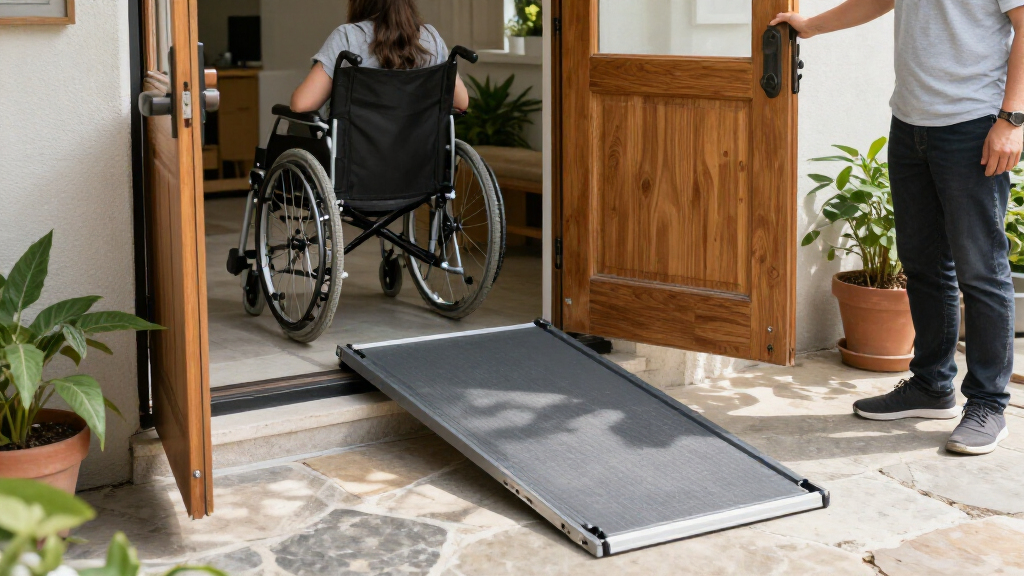
I compared these nine options by how well their designs match common wheelchair access problems: crossing a doorway lip, handling a short step, or carrying a ramp between locations. I weighed listed length and rise-related use, folding or detachable construction, portability, surface material, and stated load capacity. A longer ramp can offer a less abrupt approach, while a compact threshold model may fit a doorway better and take up less space.
The ranking favors versatility and useful reach for a broad range of access needs, which puts the VEVOR four-foot model first. Shorter folding ramps rank better for portability or modest rises, while dedicated threshold and modular products are placed for buyers whose layouts match their specific form. Capacity, material, and format are not treated as direct substitutes; buyers should confirm the product’s dimensions, load limit, and setup instructions for their own wheelchair and threshold.
| folding threshold ramps for wheelchair | Material |
|---|---|
| VEVOR 4FT Portable Aluminum Fo | Aluminum alloy |
| FACHNUO 2-Foot Portable Alumin | Aluminum |
| Nuvium 4 Inch Threshold Ramp f | Aluminum alloy |
| Rocspire 3-Foot Folding Alumin | Aluminum with stainless steel hinges |
| VNN 6-Foot Portable Aluminum W | Aluminum |
| ROBLOCK 3-Inch Rise Detachable | Eco-friendly plastic |
| Rocspire 2FT Portable Folding | Aluminum with non-slip rubber |
| 2-Foot Folding Aluminum Wheelc | Aluminum alloy |
| Pyle 4-Inch Rubber Threshold R | Rubber |
Factors to Consider When Choosing Folding Threshold Ramps For Wheelchairs
Before choosing a ramp, I’d measure the actual access problem rather than shop by the word “threshold.” The right form depends on the rise, available floor space, how often the ramp must move, and whether it needs to stay in place.
Measure the rise and available run
Measure vertically from the lower surface to the top of the threshold, then check how much clear floor space is available for the ramp. A shorter ramp covering the same rise creates a steeper approach, which can make self-propelling or caregiver-assisted use harder. Don’t rely on a product name such as “two-foot” or “four-inch” as a substitute for checking its full dimensions. Also account for door swing, nearby furniture, and the room needed to line up the wheelchair. If the available run is limited, a longer ramp may not fit even if its approach is more gradual. When the rise is substantial, ask a qualified access professional to assess the setup rather than assuming a portable ramp is suitable.
Match the ramp style to how you use the doorway
A folding ramp makes sense when it needs to be carried, stored, or moved between locations, but folding hardware and a longer panel can add bulk. A rubber threshold ramp can stay positioned at a doorway, avoiding repeated setup, though it is less suited to someone who needs a ramp to travel. Detachable modular pieces can help with certain fixed layouts, but their placement and fit need careful checking. Consider who will set up the ramp and whether they can safely unfold, position, and secure it each time. A ramp that is easy to store but inconvenient to deploy may end up being used less often. Choose based on your routine, not portability alone.
Check width, edges, and wheelchair alignment
Measure the wheelchair’s outside width, including hand rims or other parts that extend beyond the wheels, and compare it with the ramp’s usable width. The overall width printed in a listing may include side rails, so check the clear travel surface if that measurement is provided. A narrow approach can make it harder to line up a chair straight, especially in a tight doorway. Side edges may help guide wheels, but they can also affect clearance and door placement. Check whether the ramp sits flush at both ends and whether the threshold leaves a gap or lip at the connection. A good fit supports a straight, stable route rather than forcing a last-second turn.
Treat capacity as a whole-system limit
Compare the ramp’s stated capacity with the combined weight of the wheelchair, user, and anything carried on the chair. A capacity figure is not a promise that every setup is safe: load distribution, ramp support, and how the ramp rests on each surface also matter. Don’t assume that two ramps with similar dimensions have the same structural rating. Check the maker’s instructions for placement, supported surfaces, and any limits on powered or heavy wheelchairs. If the total load is close to the stated maximum, contact the manufacturer before buying. A suitable capacity needs to fit the complete setup, not just the person using it.
Account for traction, weather, and floor surfaces
Surface material affects grip, weight, cleaning, and where a ramp is practical. Textured aluminum can be portable, while rubber may offer a stable threshold-style surface; neither choice removes the need to check traction in wet or dirty conditions. For outdoor use, ask whether the specific model is rated for exposure to rain and temperature changes, and inspect its surface before each use. Indoors, consider whether rubber could mark flooring or whether a metal ramp might shift on a smooth surface. Keep the approach and landing area clear, since debris can reduce traction or obstruct wheels. Choose a ramp and placement that suit both the floor and the conditions where it will be used.
Decide when longer reach or a fixed setup is worth it
Paying for a longer ramp can make sense when the extra reach creates a gentler approach and there is room to use it. If the only barrier is a small doorway lip, a long portable panel may take up unnecessary space and be awkward to store. A fixed threshold solution can be more convenient for a frequently used entrance, but it may not work for other doors or travel. Think about whether the ramp will serve one location or several, and whether it must be removed when the doorway is not in use. Compare the cost of inconvenience—repeated setup, storage, or a poor fit—with the benefit of a more permanent arrangement. The best format is the one that fits the actual access point and daily routine.
Frequently Asked Questions
How do I tell whether a two-foot ramp will be too steep for my doorway?
Measure the vertical rise and compare it with the ramp’s actual usable length, then check the manufacturer’s guidance for the intended rise and wheelchair type. A short ramp spanning a larger rise creates a steeper approach than a longer ramp over that same height. Also consider whether the user will propel the chair independently or rely on assistance, since both affect what feels manageable. Check that there is enough clear space to position the ramp straight and support both ends. If the fit or slope is uncertain, ask an access professional before using it.
Can I leave a folding aluminum ramp in place at an exterior doorway?
That depends on the specific ramp’s outdoor-use instructions, its resistance to weather, and whether it can be secured against movement. A portable folding model may be designed for temporary placement rather than continuous exposure. Rain, dirt, and temperature changes can affect traction and the surfaces where the ramp rests. Check that doors can still operate and that the ramp does not create a trip or drainage problem. If the doorway needs permanent access, compare a fixed threshold option or ask a qualified installer about a suitable setup.
Should I choose a rubber threshold ramp or a folding aluminum ramp?
I’d favor rubber when the problem is a modest doorway lip and the ramp can remain in one location. A folding aluminum model makes more sense when the ramp must be carried, stored, or used at different access points. Compare the clear width and height fit with the threshold, rather than deciding by material alone. Check floor compatibility, traction, weight, and the product’s setup requirements. If you need one ramp for both travel and a permanent doorway, neither format may meet both needs equally well.
What weight should I use when checking a ramp’s load capacity?
Use the combined load of the person, wheelchair, and items carried on the chair, not the person’s weight alone. Include batteries or accessories that are part of the chair’s normal setup. Compare that total with the ramp’s stated capacity and follow any additional conditions in the manufacturer’s instructions. Capacity does not compensate for unstable placement or unsupported ends, so check how the ramp sits on both surfaces. If your total is close to the limit, ask the maker to confirm the intended use before purchase.
What should I check before using a portable ramp with a power wheelchair?
Check the ramp’s stated capacity, usable width, surface traction, and instructions for powered mobility devices. A power chair may be heavier than a manual chair, and its approach or turning needs can differ, so confirm that the ramp length and landing area suit the chair. Inspect the ramp for secure contact at both ends and keep the chair aligned with the travel surface. Do not assume that a general wheelchair label means every power chair is suitable. If the product documentation does not answer the question, contact the manufacturer before use.
Conclusion
For a broadly useful portable option, I’d choose the VEVOR 4FT as best overall because its longer span makes it a more flexible starting point than the shortest folding models. The FACHNUO 2-Foot is my best value-style pick for buyers prioritizing a compact ramp for a modest rise, while the Rocspire 3-Foot, 800 lb Capacity is the best premium-style choice for shoppers who put a higher listed load limit first. Beginners should start by measuring the rise, clear run, and wheelchair width before choosing between the straightforward folding aluminum options and a threshold-specific design. For a fixed doorway lip, compare the Nuvium 4 Inch and Pyle 4-Inch Rubber; for a modular layout, look at the ROBLOCK two-pack. The right pick is the one whose dimensions, capacity, and setup match your access point—not simply the longest or most portable ramp.