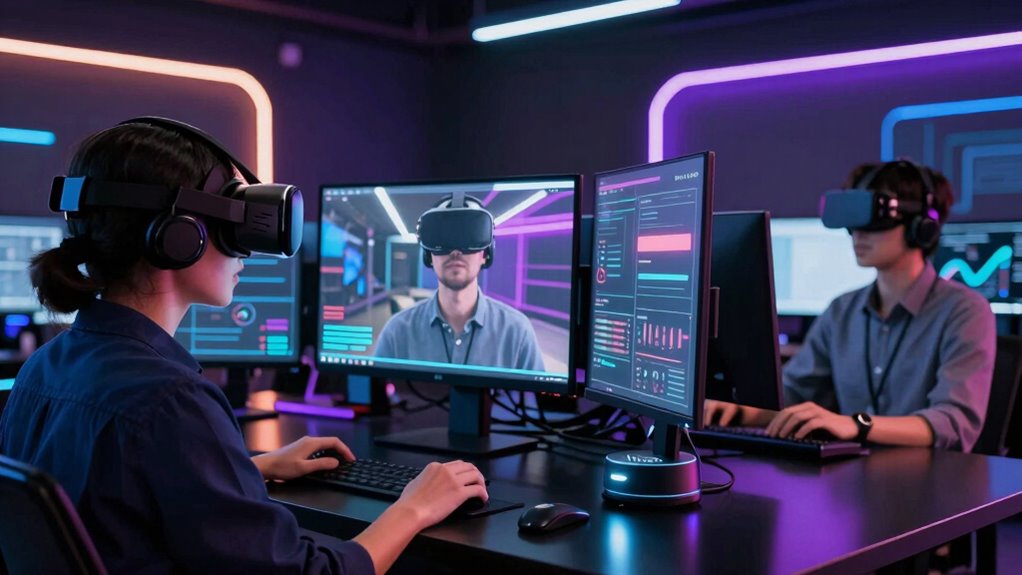

Voice technology enhances your AR and VR experiences by making interactions more natural and immersive. You can control environments, manipulate objects, and access information with simple spoken commands, reducing the need for gestures or controllers. When combined with gestures and haptic feedback, voice creates smoother, more realistic engagement. As these technologies evolve, your virtual worlds will feel even more seamless and personalized. Keep exploring to discover how these innovations are shaping your digital future.

Get everyday helpers delivered free with Prime
- Fast, free delivery on millions of items
- Prime Video, Amazon Music and more included
- Member-only deals all year
Key Takeaways
- Voice technology enhances natural, intuitive interactions, making AR and VR environments more immersive and accessible.
- It enables quick, complex commands, reducing reliance on gestures and controllers for seamless navigation.
- Combining voice with gestures and haptic feedback creates more realistic, engaging user experiences.
- Advancements in voice recognition personalize interactions, increasing user engagement and accessibility in AR/VR.
- Integration of voice tech accelerates the development of immersive applications across gaming, training, and virtual meetings.

Have you ever wondered how voice technology is transforming augmented reality (AR) and virtual reality (VR)? It’s changing the way you interact with digital environments, making experiences more intuitive and immersive. Traditionally, controlling AR and VR involved using hand gestures, controllers, or even eye movements, but voice adds a new layer of natural interaction. When you speak commands, you can navigate virtual spaces, manipulate objects, or summon information without breaking immersion. This seamless integration of voice enhances the sense of presence, making virtual worlds feel more real and accessible.
Voice technology makes AR and VR more intuitive, immersive, and natural, transforming how we interact with digital environments.
Gesture control remains essential in AR and VR, allowing you to use physical movements to interact. However, voice control offers speed and convenience, especially for complex or multiple commands. For example, instead of performing a series of gestures to open a menu, you simply say, “Open settings,” and the system responds instantaneously. This synergy between gesture control and voice commands creates a more fluid experience, reducing the cognitive load and keeping you immersed in the environment.
Haptic feedback plays a fundamental role in bridging the gap between the digital and physical worlds. When combined with voice commands, haptic feedback gives you tactile cues that confirm your actions, making interactions feel more tangible. Imagine saying, “Pick up the virtual key,” and feeling a slight vibration in your controllers as the object is grasped. This sensory reinforcement makes interactions more realistic, helping you trust the system and stay engaged longer. The integration of voice with haptic feedback also allows for more detailed and complex interactions, as you can give voice commands while feeling the results through subtle vibrations, enhancing the immersive experience. Additionally, haptic technology is continually evolving to provide more precise and varied tactile sensations, further enriching the immersive experience.
As voice technology advances, its integration with gesture control and haptic feedback will only deepen. You’ll find yourself exploring virtual worlds with greater ease, issuing commands naturally while feeling the virtual environment respond in real time. Whether it’s gaming, training simulations, or virtual meetings, voice-powered controls make these experiences more intuitive and accessible. Additionally, understanding how projector technology enhances visual experiences helps us appreciate the importance of immersive content in AR and VR environments. The combination of speech, gestures, and tactile feedback creates a richer, more immersive reality—one where you’re not just observing but actively participating. Moreover, as voice recognition systems become more sophisticated, they will increasingly adapt to individual users, making interactions even more seamless and personalized. This evolution signifies a future where AR and VR feel less like technology and more like an extension of your physical self.
As an affiliate, we earn on qualifying purchases.
Frequently Asked Questions
How Does Voice Recognition Improve User Immersion in AR and VR?
Voice recognition enhances your immersion in AR and VR by allowing you to control environments with natural speech, reducing the need for manual gestures. When combined with gesture control, it creates seamless interactions, making you feel more present. Spatial audio further immerses you by delivering realistic sound cues based on your voice commands, making virtual worlds feel more authentic and engaging, drawing you deeper into the experience.
What Are the Privacy Concerns With Voice Data in Ar/Vr?
Imagine you’re playing a VR game that records your voice commands. You might worry about data security and how your voice data is stored or shared. Privacy concerns arise if companies don’t get your user consent or mishandle your data. You need transparency from providers about how your voice data is used, stored, and protected—ensuring your privacy rights are respected while enjoying immersive AR and VR experiences.
How Do Accents Affect Voice Command Accuracy in Immersive Environments?
Accent variation can considerably impact voice command accuracy in immersive environments, as different accents may challenge speech recognition systems. You might find that speech clarity varies based on your accent, causing misinterpretations. To improve accuracy, make sure your voice assistant is trained on diverse accent samples, and speak clearly. Developers can also enhance system performance by refining algorithms to better recognize accent variation, making voice commands more reliable for everyone.
Can Voice Work Enhance Accessibility for Disabled Users in Ar/Vr?
Voice work acts like a bridge, opening doors for disabled users in AR and VR. You can leverage voice coaching to fine-tune commands, making interactions smoother. Sound design adds layers of clarity and reassurance, transforming the experience into a welcoming space. Together, they turn technology into an inclusive tool, ensuring everyone can explore virtual worlds with confidence and ease, regardless of physical limitations.
What ARe the Future Trends in Voice Technology for AR and VR?
You’ll see future trends in AR and VR voice technology focusing on synthetic voices that sound more natural and expressive, making interactions more immersive. Voice biometrics will become essential for secure, personalized experiences, allowing seamless access and customization. As these advancements develop, you’ll notice more realistic voice assistants and enhanced security, making your virtual environments feel more authentic and tailored to your needs.
As an affiliate, we earn on qualifying purchases.
Conclusion
As you step further into the AR and VR landscape, imagine voice work as a guiding beacon softly illuminating your path, making interactions feel natural and intuitive. It gently weaves your voice into the immersive tapestry, enhancing the experience without overwhelming it. Embracing this harmony, you’ll find your journey becoming smoother, like a subtle breeze guiding you through uncharted digital worlds, where technology and human connection dance seamlessly to create truly mesmerizing adventures.
As an affiliate, we earn on qualifying purchases.
virtual reality controllers with voice commands
As an affiliate, we earn on qualifying purchases.
As an affiliate, we earn on qualifying purchases.
Halloween Picks
halloween
As an affiliate, we earn on qualifying purchases.