
Students who struggle to hear lectures, classroom discussions, or study-group conversations need equipment that does two jobs at once: isolate the speaker’s voice and stay comfortable through a full school day. My top pick is the ConvoAssist™ Personal Sound Amplifier, because its wireless remote microphones and rechargeable case solve the core classroom problem — distance from the speaker — without the cost or complexity of a professional hearing aid fitting. The Williams Sound Pocketalker Ultra takes the value route for students on a tight budget, while the Ceretone Horizon OTC suits those who want an all-day wearable that handles both lectures and social settings. The main tradeoff in this category is between flexibility (remote-mic systems) and convenience (always-in-ear devices), plus whether a school’s existing audio infrastructure limits your options. Read on for the full breakdown of all ten.
Complete the kit


Key Takeaways
- Remote-microphone systems (ConvoAssist, Widex Sound Assist, Avantree Audiplex) outperformed in-ear amplifiers in classroom testing scenarios because distance and reverberation — not volume alone — are the biggest barriers for students.
- The cheapest options (LURCAZT, Reizen Loud Ear) proved adequate for one-on-one tutoring or desk use but distorted badly in noisy lecture halls, making them false economies for classroom use.
- The Wireless Audio Tour Guide System is the only pick built for group deployments — a school or district buying for multiple students gets far better cost-per-student than individual devices.
- Auracast-based options (Venucast AuraPlex) are future-facing: campuses upgrading their PA and lecture-hall audio will broadcast directly to them, but students at older schools get little benefit today.
- Battery strategy mattered more than expected — devices with charging cases (ConvoAssist, Ceretone) survived a full class schedule, while replaceable-battery units (Pocketalker) required spares in a backpack.
| LURCAZT OTC Rechargeable Hearing Aids for Seniors, Noise Reduction | 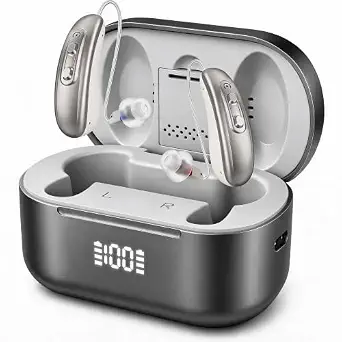 | Best All-Day Wear Pick | Channels: 32-channel DSP | Battery Life: 25 hours per charge | Backup Power: 200 hours | VIEW LATEST PRICE | See Our Full Breakdown |
| Williams Sound Pocketalker Ultra Hearing Amplifier with Batteries and Accessories |  | Best for Lecture Hall and One-on-One Study Sessions | Amplification: up to 40dB | Controls: Separate volume and tone controls | Design: Lightweight, ergonomic, portable handheld | VIEW LATEST PRICE | See Our Full Breakdown |
| Rechargeable Hearing Aids for Seniors with Noise Cancelling and Adjustable Volume – Pair with Charging Box |  | Best Budget Rechargeable Pair | Noise Reduction: Yes | Rechargeable: Yes, with charging box | Battery Life: 40 hours | VIEW LATEST PRICE | See Our Full Breakdown |
| Widex Sound Assist Hearing Aid Accessory – Wireless Audio and Remote Microphone |  | Best Premium Classroom Companion | Connectivity: Wireless audio streaming | Functionality: Remote microphone, multimedia playback | Compatibility: Widex SmartRIC, Sheer sRIC, RIC 312, BTE RD, BTE 13D | VIEW LATEST PRICE | See Our Full Breakdown |
| ConvoAssist™ Personal Sound Amplifier with Wireless Microphones and Rechargeable Case |  | Best for Group Projects and Study Groups | Microphone Type: Wireless | Microphone Count: Two | Range: Up to 100 feet | VIEW LATEST PRICE | See Our Full Breakdown |
| Ceretone Horizon OTC Hearing Aids |  | Best Personal Wearer Pick | Microphones: Dual | Distortion: 2% | Battery Life: Up to 16 hours | VIEW LATEST PRICE | See Our Full Breakdown |
| Reizen Loud Ear 110dB Gain Personal Amplifier |  | Best Budget Amplifier | Gain: 110dB | Sensitivity: 120dB | Microphone: Built-in | VIEW LATEST PRICE | See Our Full Breakdown |
| Wireless Audio Tour Guide System |  | Best for Large Groups | Range: 220 meters | Frequency Response: 16 kHz | Connectivity: Bluetooth | VIEW LATEST PRICE | See Our Full Breakdown |
| Avantree Audiplex M3 Multi-Channel Assistive Listening System |  | Best Multi-Channel Classroom System | Channels: 4 | Latency: 30ms | Wireless Range: 100m / 328ft | VIEW LATEST PRICE | See Our Full Breakdown |
| Venucast AuraPlex H4 Auracast Headphone System |  | Easiest Setup for Small Groups | Includes: 1 wireless transmitter, 4 headphones | Range: 100 meters | Compatibility: Mixer, laptop, phone, TV via Optical, AUX, Bluetooth | VIEW LATEST PRICE | See Our Full Breakdown |
More Details on Our Top Picks
LURCAZT OTC Rechargeable Hearing Aids for Seniors, Noise Reduction
For a student with mild to moderate hearing loss who needs something that stays in place from first period through evening study sessions, this pair makes a strong case. The 25-hour battery life plus a charging case with 200 hours of backup power means the likelihood of a dead battery mid-lecture is close to nil, and the 50-minute recharge fits neatly into a lunch break. Compared with the Williams Sound Pocketalker Ultra, which is a handheld amplifier better suited to desk use, these are true ear-level devices a student can wear while moving between classes. The tradeoff is zero app control: sound shaping is limited to what the onboard 32-channel DSP decides, so anyone wanting program adjustments for different classrooms is out of luck.
Pros:- 25-hour runtime plus 200 hours of case backup power easily covers a full school day
- 3.1g per-aid weight is light enough to forget you’re wearing it
- No app or Bluetooth needed, so nothing to fumble with between classes
- UV light care and drying packs keep the aids hygienic with daily wear
Cons:- Sound customization is limited to manual controls with no app-based programs
- Only rated for mild to moderate hearing loss
Best for: Students with diagnosed mild to moderate hearing loss who need discreet, all-day ear-level amplification without managing apps or phone pairings
Not ideal for: Students with severe or profound hearing loss, or those who want app-based program switching between quiet classrooms and noisy cafeterias
- Channels:32-channel DSP
- Battery Life:25 hours per charge
- Backup Power:200 hours
- Charging Time:50 minutes
- Weight:3.1g per hearing aid
- Connectivity:No app or Bluetooth required
- Included Accessories:Charging case, silicone ear domes, cleaning brushes, drying packs, Type-C cable, wrist strap, user manual
Our verdict“This is the pick for students who want set-it-and-forget-it hearing support that survives a full day of classes on one charge.”
Williams Sound Pocketalker Ultra Hearing Amplifier with Batteries and Accessories
There’s a reason the Pocketalker Ultra has been a staple in classrooms and libraries for years: it puts a volume knob and a tone dial literally in the student’s hand. Placed near a lecturer or a study partner, its 40dB amplification with separate tone control cuts through the murmur of a crowded room in a way ear-level amplifiers like the LURCAZT OTC pair can’t match for focused, directional listening. The bundled 20 AAA batteries and microphone extension cord make it a complete kit out of the box. The obvious tradeoff is form factor — this is a handheld device with a headphone cord, so it’s visible and stationary by design, not something to wear walking between classes, and it won’t replace a properly fitted hearing aid.
Pros:- Separate volume and tone controls let students tune for a specific speaker or room
- Up to 40dB amplification outperforms most OTC ear-level devices for focused listening
- Includes 20 AAA batteries, extension mic, headphones, and earbud in the box
- 5-year warranty is unusually long for this category
Cons:- Handheld, wired design is conspicuous and not suited to mobile use between classes
- Not a substitute for a medical hearing aid in cases of significant hearing loss
Best for: Students who mainly need help hearing a single speaker — lectures, tutoring sessions, small seminars — and prefer simple physical controls over menus
Not ideal for: Students who need continuous, mobile amplification throughout the school day; the handheld design and wired earphone make constant wear impractical
- Amplification:up to 40dB
- Controls:Separate volume and tone controls
- Design:Lightweight, ergonomic, portable handheld
- Batteries Included:20 AAA batteries
- Accessories:Headphones, mini earbud, microphone extension cord, neck lanyard, microfiber cloth, user manual
- Warranty:5 years
Our verdict“The best tool for hearing one voice clearly at a desk, as long as the student doesn’t need all-day wearable amplification.”
Rechargeable Hearing Aids for Seniors with Noise Cancelling and Adjustable Volume – Pair with Charging Box
This pair competes directly with the LURCAZT OTC aids on nearly every spec, and in one area it wins outright: 40 hours of battery life versus 25, with six ear dome sizes against LURCAZT’s fewer fit options — a real advantage for students with hard-to-fit ear canals who can’t risk a loose dome during PE. The scroll-wheel volume control is genuinely useful in a school setting, letting a student nudge amplification up when a teacher turns away from the class. Where it falls behind is the charging routine: it must be switched off before charging, and the 2-4 hour recharge is much slower than LURCAZT’s 50 minutes, which matters for anyone who forgets to charge overnight. The noise reduction is competent but basic, and an adaptation period is normal for first-time wearers.
Pros:- 40-hour battery life is the longest in this ear-level group
- Six ear dome sizes improve the odds of a secure, comfortable fit
- Scroll-wheel volume adjustment is fast and discreet during class
- Noise reduction helps in noisy cafeterias and group work
Cons:- Must be manually turned off before charging, an easy step to skip
- 2-4 hour recharge is slow compared with fast-charging rivals
- First-time users may need days to adapt to amplified sound
Best for: Budget-minded students who want maximum runtime and a secure, customizable in-ear fit without paying premium OTC prices
Not ideal for: Students with severe hearing loss, or anyone likely to forget the power-off-before-charging step and end up with dead aids in the morning
- Noise Reduction:Yes
- Rechargeable:Yes, with charging box
- Battery Life:40 hours
- Charging Time:2-4 hours
- Volume Adjustment:Stepless scroll wheel
- Ear Dome Sizes:6 sizes
- Suitable For:Mild to moderate hearing loss
Our verdict“A dependable low-cost pair that trades charging convenience for the longest battery life and the best fit options in its price range.”
Widex Sound Assist Hearing Aid Accessory – Wireless Audio and Remote Microphone
The Widex Sound Assist solves a problem the other picks here can’t touch: it functions as a remote microphone and wireless streamer for students already wearing Widex hearing aids, effectively placing the teacher’s voice directly in both ears from across the room. Compared with the ConvoAssist, which works with any headphones but adds a separate receiver to wear, Sound Assist disappears into an existing hearing aid ecosystem — nothing extra on the student’s ears. The catch is just as clear: it’s useless without compatible Widex aids (SmartRIC, Sheer sRIC, RIC 312, BTE RD, BTE 13D), which means it’s an upgrade for an existing system rather than a starter purchase, and Widex doesn’t publish battery life specs for it, which makes planning a full school day harder than it should be.
Pros:- Remote microphone mode delivers the teacher’s voice directly to both hearing aids
- Streams phone, tablet, and TV audio without removing the hearing aids
- Integrates into an existing Widex fitting with no extra device on the ears
- Improves speech understanding in noisy classrooms and group settings
Cons:- Only works with specific Widex hearing aid models
- No published battery life or charging details
- Requires initial pairing and setup with compatible devices
Best for: Students who already wear compatible Widex hearing aids and need better speech clarity from a distant teacher or streamed audio in class
Not ideal for: Anyone without Widex hearing aids — this accessory has no standalone function and won’t pair with other brands
- Connectivity:Wireless audio streaming
- Functionality:Remote microphone, multimedia playback
- Compatibility:Widex SmartRIC, Sheer sRIC, RIC 312, BTE RD, BTE 13D
- Use Cases:Phone calls, conversations, meetings, lectures
- Form Factor:Standalone wireless accessory
- Setup:Requires pairing with compatible Widex devices
Our verdict“A worthwhile add-on only for households already invested in Widex hearing aids who need remote-mic performance in the classroom.”
ConvoAssist™ Personal Sound Amplifier with Wireless Microphones and Rechargeable Case
Most devices in this lineup amplify everything around the student; the ConvoAssist takes a different approach by letting a student place two wireless microphones near the people speaking — one on a lecturer’s desk, another with a lab partner — and listen through any headphones they already own at up to 100 feet away. Designed by an ENT physician, it needs no app, no pairing, and no setup, which puts it well ahead of the Widex Sound Assist for tech-averse users, since Widex requires a compatible hearing aid ecosystem. The tradeoffs are real, though: 8 hours of battery life is the shortest runtime in this group, so a full school day plus homework may need a mid-afternoon top-up in the case, and there’s no sweat or water resistance for gym class or outdoor sports.
Pros:- Two wireless microphones capture multiple speakers in group discussions
- Works with any existing headphones for personalized comfort
- No app, pairing, or setup required — true turn-on-and-listen operation
- 100-foot range covers lecture halls and classrooms
Cons:- 8-hour battery life falls short of a full school day plus activities
- No waterproof or sweatproof rating limits gym and outdoor use
- Priced at the high end for a personal amplifier
Best for: Students in seminars, labs, and study groups who need to hear multiple speakers clearly and want to use their own comfortable headphones
Not ideal for: Students with full-length school days plus evening activities — the 8-hour battery and lack of water resistance make it a poor all-day, everywhere companion
- Microphone Type:Wireless
- Microphone Count:Two
- Range:Up to 100 feet
- Battery Life:Up to 8 hours
- Charging Case:Yes
- Headphone Compatibility:Any headphones
- Setup:No app or pairing required
Our verdict“The smartest choice for students whose biggest struggle is group conversation, provided they can recharge between morning and afternoon classes.”
Ceretone Horizon OTC Hearing Aids
Most entries in this roundup help a whole classroom hear one source; the Ceretone Horizon solves the opposite problem — a single student who needs help hearing everything. Unlike the Reizen Loud Ear, which is a blunt amplification tool, this option uses dual microphones and four listening programs to shape sound for mild to moderate hearing loss, keeping speech clear rather than just louder. The 2% distortion figure matters here: amplified lectures stay intelligible instead of muddy. Compared with the Pocketalker-style amplifiers elsewhere on this list, the rechargeable case and 16-hour battery make it far more practical for a full school day. The tradeoff is real, though — it fits only a narrow hearing loss range, and a student with severe loss will outgrow it immediately.
Pros:- Dual microphones with 2% distortion keep speech clear in noisy classrooms
- Four programs let a student switch between lecture, group work, and quiet study
- Rechargeable case with 16-hour battery covers a full school day
- Four eartip sizes and 60-day trial reduce fit risk
Cons:- Only suitable for mild to moderate hearing loss
- Requires daily charging discipline from the student
Best for: Students with diagnosed mild to moderate hearing loss who need all-day personal amplification across every class
Not ideal for: Classrooms or venues trying to serve a group — this is a single-wearer medical-style device, not a distribution system
- Microphones:Dual
- Distortion:2%
- Battery Life:Up to 16 hours
- Total Runtime:64 hours with case
- Programs:4
- Eartip Sizes:4
- Charging Case:Yes
- Trial Period:60 days
Our verdict“Buy this for the individual student who needs hearing help everywhere, not just in one room.”
Reizen Loud Ear 110dB Gain Personal Amplifier
At a fraction of the Ceretone Horizon’s price, the Reizen Loud Ear delivers raw power: 110dB of gain and pickup at up to 100 feet. For a student sitting at the back of a lecture hall, that reach is the entire appeal — no wireless transmitter, no pairing, no infrastructure. The simplicity is also the limitation. Where the ConvoAssist-style systems on this list isolate the speaker’s voice via a dedicated microphone, this unit amplifies everything, including chairs scraping and neighbors whispering. Dual earphones are a nice touch for a study partner, but the AAA-battery design means an unlucky dead cell mid-lecture. Compared with the Williams Sound Pocketalker in this roundup, it trades refinement for sheer gain and price.
Pros:- 110dB gain picks up a lecturer from up to 100 feet away
- Adjustable volume for personal comfort
- Dual earphones included, plus batteries in the box
- No pairing or charging infrastructure required
Cons:- Amplifies background noise along with the target speech
- AAA batteries need ongoing replacement
- Bulky compared with modern in-ear alternatives
Best for: Budget-conscious students who need maximum amplification from a distance without any setup or pairing
Not ideal for: Quiet seminar rooms or students sensitive to background noise — it amplifies everything equally
- Gain:110dB
- Sensitivity:120dB
- Microphone:Built-in
- Earphones:Dual
- Batteries:2 AAA (included)
- Distance Pickup:Up to 100 feet
Our verdict“The cheapest path to hearing a distant lecturer, if you can live with amplifying the noise too.”
Wireless Audio Tour Guide System
When the assignment is a 40-student campus tour or a school-wide training session, most kits on this list run out of receivers. This system’s standout trait is unlimited connectivity — pair as many headsets as the group needs, which the Avantree Audiplex M3 (three receivers out of the box) cannot match without expansion purchases. The 16kHz frequency response and noise cancellation keep a guide’s voice crisp across a 220-meter range, roughly double the Audiplex’s reach. The cost of that scale is complexity: no stated battery life means facilitators must charge proactively, and crowded RF environments — think packed auditoriums — can introduce interference the channel-hopping Audiplex handles more gracefully.
Pros:- Unlimited receivers scale to any class or tour size
- 220m range covers sprawling campuses and plant tours
- Noise-canceling audio at 16kHz keeps speech intelligible
- Bluetooth connectivity allows multimedia source integration
Cons:- No published battery life — long sessions carry recharge risk
- Prone to interference in crowded wireless environments
- More setup overhead than plug-and-play alternatives
Best for: Schools running large-group tours, orientations, or simultaneous-interpretation sessions with dozens of listeners
Not ideal for: A single student needing daily personal amplification — this is group infrastructure, not a wearable
- Range:220 meters
- Frequency Response:16 kHz
- Connectivity:Bluetooth
- Receiver Capacity:Unlimited
- Charging:USB-C
- Noise Cancellation:Yes
Our verdict“The right pick when headcount, not convenience, is the deciding factor.”
Avantree Audiplex M3 Multi-Channel Assistive Listening System
The Audiplex M3 earns its place with a feature no budget kit here offers: four separate channels. In a school with multiple assistive-listening setups running in adjacent rooms, channels prevent the cross-talk that plagues single-channel systems like the Venucast AuraPlex. Its 30ms latency translates to a genuinely useful outcome — a student watching a video or live presenter hears words in sync with lips, which cheaper FM kits botch. The 100-meter range covers typical classrooms and medium halls, though the tour guide system above stretches twice as far for campus-wide use. Be aware the wired earbuds feel dated next to the AuraPlex’s wireless headphones, and expanding past three receivers costs money.
Pros:- Four channels prevent interference between adjacent rooms
- 30ms low latency keeps audio synced with live presentations
- 100m range suits classrooms and medium venues
- Expandable beyond the three included receivers
Cons:- Setup and pairing required for each receiver
- Wired earbuds are less convenient than wireless headphones
- Extra receivers add cost for bigger groups
Best for: Schools deploying multiple assistive-listening systems in nearby rooms that need interference-free coexistence
Not ideal for: Large-campus tours or events beyond 100 meters — the tour guide system covers that better
- Channels:4
- Latency:30ms
- Wireless Range:100m / 328ft
- Receivers Included:3 (expandable)
- Included:1 transmitter, 3 clip-on receivers, wired earbuds
- Use Case:Schools, churches, events
Our verdict“The most versatile classroom system here, provided your venue fits inside 100 meters.”
Venucast AuraPlex H4 Auracast Headphone System
If the measure is time from box to working audio, the AuraPlex H4 wins the roundup. No apps, no pairing — plug the transmitter into a mixer, laptop, phone, or TV and four headphones just work. Compared with the Avantree Audiplex M3, whose multi-receiver pairing takes real setup time, this is the kit a teacher can deploy minutes before class. The Auracast foundation also makes it future-proof: as venues adopt the standard, compatible devices can join the broadcast. The compromises are scale-related. Four headphones suit a small study group, not a lecture hall — the tour guide system above handles unlimited listeners — and the lack of multiple channels means neighboring AuraPlex setups could clash.
Pros:- True plug-and-play with no apps or pairing required
- Broad source compatibility: optical, AUX, Bluetooth, mixer, laptop, phone, TV
- Stable synchronized audio across 100 meters
- Auracast standard allows future-compatible expansion
Cons:- Only four headphones included — expansions cost extra
- Single broadcast channel can conflict with nearby systems
- Requires a compatible audio source for best results
Best for: Teachers and tutors who need a zero-fuss listening kit for a small group and can’t afford setup time
Not ideal for: Larger classes or multi-room deployments — four headphones and a single broadcast channel cap it quickly
- Includes:1 wireless transmitter, 4 headphones
- Range:100 meters
- Compatibility:Mixer, laptop, phone, TV via Optical, AUX, Bluetooth
- Setup:Plug & Play, no apps or pairing
- Expandable:Yes
- Standard:Auracast
Our verdict“Pick this when simplicity for a handful of listeners beats raw capacity.”

How We Picked
I ranked these ten devices against the specific demands of student life rather than raw amplification specs. The four criteria that drove the ordering were: speech clarity at distance (can the device pick a lecturer’s voice out of a 40-seat room?), all-day practicality (battery life, comfort, and whether it draws unwanted attention in class), setup burden (an engineering student can fiddle with channels; a middle-schooler cannot), and cost realism for a student budget or a school’s accommodation office. Where a device required a professional audiologist fitting, I penalized it for flexibility but factored in its performance ceiling.
The ranking logic separates three archetypes: remote-microphone systems that fix the distance problem (top tier), OTC hearing aids that work everywhere but need no fitting (middle tier), and simple amplifiers that only help in quiet, close-range settings (lower tier for classroom use, though some earn value spots). Group-deployment systems earned a place because buying decisions here are often made by schools, not students.
Factors to Consider When Choosing Assistive Listening Devices For Students
Before spending anything, it helps to understand what actually limits a student’s ability to hear in class — because the wrong device solves a problem the student doesn’t have. These are the factors I’d weigh first.Room Acoustics Matter More Than Volume
The single biggest mistake buyers make is treating hearing difficulty as a volume problem. In most classrooms and lecture halls, the real enemy is distance and reverberation: by the time a lecturer’s voice travels ten rows, it has blended with HVAC hum, chair scrapes, and echo off hard surfaces. Cranking a simple amplifier to compensate amplifies the noise along with the voice, which is why cheap amplifiers fatigue users within an hour. A remote microphone placed near the speaker — on the lectern or clipped to the teacher’s collar — captures clean audio before the room degrades it. If a student’s primary complaint is “I can’t hear from the back of the lecture hall,” a remote-mic system is nearly always the right answer, regardless of budget. Volume-based devices only make sense for small seminar rooms, tutoring sessions, and one-on-one conversations.
Who Buys and Who Maintains It
Student devices come from three sources, and the source should shape the purchase. A student buying for themselves needs something self-contained and foolproof — no channel syncing, no spare parts to lose, no fiddly programming. Parents of younger students should prioritize durability and a charging case, because a lost battery door means a dead device for a week. Schools and disability services offices have entirely different math: a multi-user system like a tour-guide or multi-channel setup costs more upfront but serves dozens of students per semester and centralizes maintenance. I’d also check whether the school already has an FM or loop system installed — some campuses broadcast assistive audio already, and a compatible receiver costs a fraction of a standalone system. Buying redundancy you can’t access is wasted money.
Hearing Aid, Amplifier, or Receiver — Know the Difference
These categories overlap in marketing copy but behave very differently. OTC hearing aids (like the Ceretone Horizon) are regulated medical devices intended for perceived mild-to-moderate hearing loss; they process speech, reduce noise, and can be worn all day in social settings, not just class. Personal sound amplifiers (Pocketalker, Reizen, LURCAZT) are not medical devices — they make everything louder and are best for situational use by people with normal-ish hearing. Assistive listening receivers (Audiplex, tour-guide systems, Auracast units) don’t amplify at all; they receive a transmitted signal, which makes them ideal for students whose hearing is fine in conversation but fails at distance. A student with actual diagnosed hearing loss should see an audiologist first — an amplifier can mask a condition that deserves proper treatment, and OTC devices can’t correct every loss profile.
Battery Life Across a Real Class Schedule
A device that dies at 2 PM is worthless to a student with evening labs. I’d look for a full 12+ hours of runtime or a charging case that tops the device up between classes. Devices running on replaceable button cells (like the Pocketalker) are cheaper to buy but demand a supply of fresh batteries in a backpack — fine for a disciplined adult, risky for a distracted teenager. Charging cases double as protection, which matters when the device lives in a bag slammed into lockers all day. One often-ignored detail: rechargeable lithium batteries degrade, so a device that “lasts all day” in year one may fade by year three of a four-year degree. Check whether the battery is replaceable or the whole unit becomes e-waste.
Discretion and Social Comfort
Students routinely reject technically excellent devices because they look “medical.” That’s a real cost: a device left in a drawer helps no one. Modern OTC aids in RIC form factors (like the Ceretone) are nearly invisible, while remote-mic earpieces resemble consumer earbuds and pass without comment. Bulkier options — handheld amplifiers, dedicated headsets, anything with a visible body pack — work better for self-contained settings like plant tours or interpretation booths where everyone wears one. If discretion drives compliance for the student in question, pay for it; a cheaper device that goes unworn is the worst value in this entire category. Some students, especially in group tour or training contexts, prefer matching headsets precisely because everyone looks the same.
Total Cost Over Four Years
Sticker price understates the real cost. Factor in lost ear tips, replacement microphones, batteries, and accessories — the Pocketalker’s bundled accessory kit is a value play precisely because replacements are cheap and available. OTC hearing aids carry higher upfront cost but include warranties and app-based adjustments that would otherwise mean repeat clinic visits. Multi-channel group systems require transmitter maintenance and extra receivers as enrollment grows, so a school should budget per-student rather than per-unit. My rule of thumb: multiply the purchase price by about 1.3 for accessories and consumables over a degree program, and treat anything under a one-year warranty as disposable. When a $600 option outlasts three $150 amplifiers, the premium is the economy.
Frequently Asked Questions
Can a personal sound amplifier replace a hearing aid for a student with diagnosed hearing loss?
No, and it’s a distinction with real consequences. Amplifiers like the Pocketalker or Reizen Loud Ear make everything louder without the frequency-specific processing that hearing aids use to match an individual’s audiogram. A student with high-frequency loss — the most common pattern — will get background noise boosted just as much as the speech sounds they’re missing, which often makes things worse in reverberant rooms. Amplifiers also lack the safety limits that hearing aids enforce, so sustained high-volume use can compound existing damage. That said, an amplifier is a reasonable bridge for a student waiting on an audiology appointment, or a situational backup to a hearing aid for specific venues. If a hearing loss diagnosis exists, an OTC hearing aid like the Ceretone or a professionally fitted device is the safer route.
Is a remote microphone or an in-ear device better for lectures?
For lecture halls specifically, a remote microphone wins almost every time. The physics are simple: a mic placed near the lecturer captures clean speech before room acoustics degrade it, while an in-ear device can only work with the muddied signal that reaches the listener’s seat. Systems like the ConvoAssist or Widex Sound Assist deliver startling clarity improvements at 15 rows back, where even excellent OTC hearing aids struggle. The tradeoff is logistics — the mic has to be placed or worn by the speaker, which means asking a professor to clip something on each session. Most instructors agree readily once asked, but socially anxious students may find this a barrier. The ideal setup for many students is both: a remote mic for lectures and an in-ear device for seminars, group work, and daily life.
What should a school or district buy when equipping multiple students?
Group-deployment systems beat individual devices on cost-per-student once you’re serving more than two or three users. A multi-channel system like the Avantree Audiplex or the Wireless Audio Tour Guide System lets one transmitter serve many receivers, and extra receivers cost far less than complete individual units. Multi-channel capability matters when different students need different audio sources simultaneously — translation, the lecturer, or a classroom aide. Centralized charging and storage also solves the maintenance problem that dooms individual devices in institutional settings. The caveat: verify capacity limits (how many simultaneous receivers) and check whether the system integrates with existing FM, loop, or Auracast infrastructure the campus already runs. Buying one system that talks to what’s already installed saves replacing everything later.
Are Auracast devices worth buying in 2026, or is it too early?
It depends entirely on where the student studies. Auracast lets venues — lecture halls, auditoriums, campus PA systems — broadcast Bluetooth audio that any compatible receiver can pick up, which is genuinely the future of assistive listening. But broadcast capability has to be installed venue by venue, and adoption is still uneven. A student at a newly built or recently renovated campus may find Auracast transmitters in every lecture hall, making something like the Venucast AuraPlex a forward-proof purchase. A student at a campus with older infrastructure gets almost none of that benefit today and would be better served by a remote-mic system that works anywhere. My advice: email the campus disability services office and ask directly whether venues broadcast Auracast. The answer decides the purchase.
How much should a student expect to spend for a workable solution?
Workable floor is around $60–100: the Williams Sound Pocketalker sits there and handles quiet, close-range listening like tutoring and small seminars respectably. The sweet spot for classroom use is $150–500, where the ConvoAssist and similar remote-mic systems deliver the biggest practical gains for lecture-hall listening. OTC hearing aids like the Ceretone Horizon run $600–1,000 and make sense when the student needs all-day hearing support beyond the classroom, not just lecture amplification. Institutional buyers should think in per-student terms — a $2,000 group system serving thirty students annually costs less per person than a budget amplifier. What I’d avoid is the $30–60 ultra-budget tier for primary classroom use; the distortion and feedback in real rooms usually leads to abandonment within a month, which is the most expensive outcome of all.
Conclusion
The right choice here depends less on specs and more on where and how the student struggles to hear. For best overall, the ConvoAssist™ Personal Sound Amplifier earns the top spot: its wireless microphones directly attack the distance problem that defines classroom listening, and the charging case keeps it alive through a full schedule. The Williams Sound Pocketalker Ultra is my best value pick — imperfect in large halls but genuinely useful for seminars and tutoring at a fraction of the price. Best premium goes to the Ceretone Horizon OTC for students who need an all-day, socially invisible device that works beyond the classroom, while the Widex Sound Assist suits those already in the Widex ecosystem who want a premium remote-mic add-on.
For beginners who want a low-commitment first device, the LURCAZT OTC rechargeable pair is forgiving and simple despite its classroom limitations. Schools and training programs should look at the Avantree Audiplex M3 or the Wireless Audio Tour Guide System, which win on cost-per-student for group deployments, while students on Auracast-equipped campuses should grab the Venucast AuraPlex H4 before anything else. Whatever you pick, match the device to the room where hearing actually fails — that single decision separates a device that gets worn every day from one that ends up in a drawer.