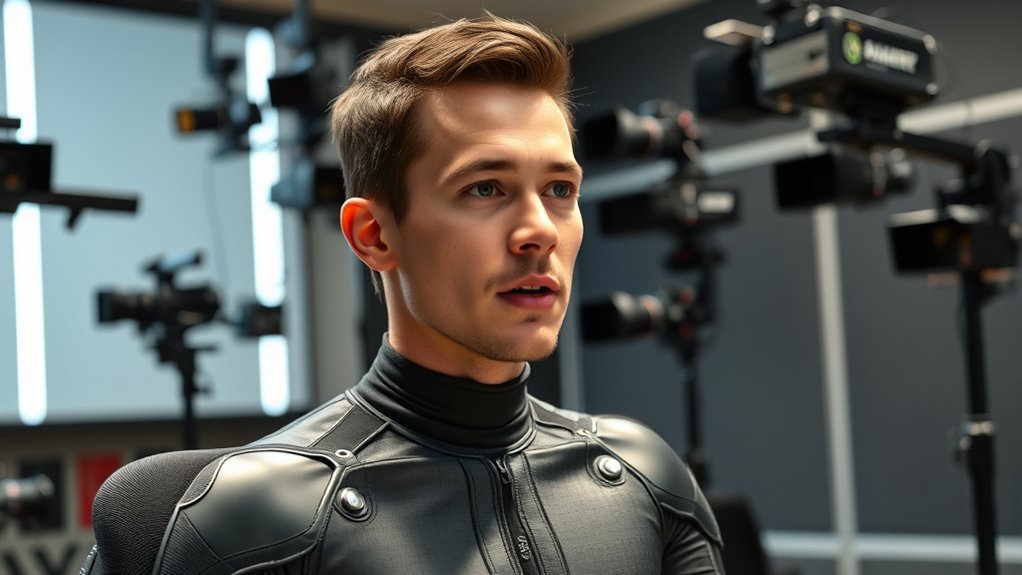

To excel in motion capture acting as a voice actor, focus on developing your facial expressions and physical improvisation skills. Use real-time facial movements and micro-expressions to convey emotion naturally, while exploring spontaneous body gestures to add depth. Practice staying aware of your entire body language, as it reinforces your character’s emotional tone. With consistent effort and openness to improvisation, you’ll create more authentic performances. Keep exploring these techniques to enhance your mocap presence even further.
Key Takeaways
- Develop awareness of facial expressions and micro-expressions to accurately convey emotion during mocap sessions.
- Use physical improvisation exercises to explore spontaneous movements that enhance character authenticity.
- Integrate full-body gestures and posture to reinforce emotional tone alongside facial cues.
- Practice adaptability by experimenting with different physical strategies to find natural, believable performances.
- Focus on consistent, expressive physical and facial cues to improve overall performance quality in digital characters.
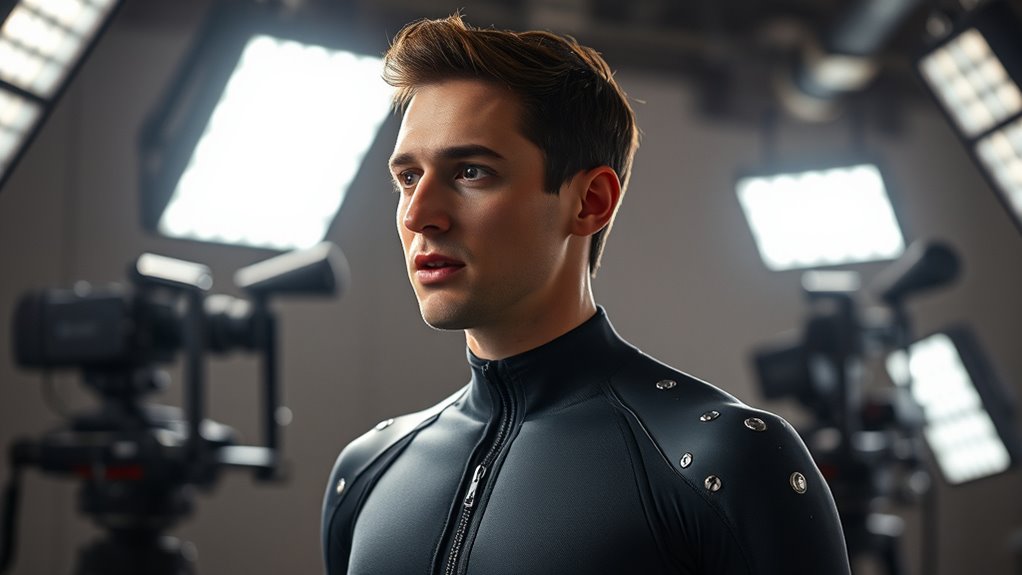
Motion capture acting has become an indispensable part of modern filmmaking and video game development, allowing performers to bring digital characters to life with remarkable realism. As a voice actor stepping into the mocap arena, you’ll discover that your facial expressions and physical improvisation are key tools in conveying emotion and personality. Unlike traditional voice acting alone, mocap requires you to use your entire body as an expressive instrument. Your facial movements, subtle micro-expressions, and physical gestures are captured in real time, translating your performance into a digital character that feels authentic and compelling. This means that every smirk, raised eyebrow, or clenched fist can considerably influence how the character is perceived, making your awareness of facial expressions paramount.
Physical improvisation plays an essential role in mocap acting because it encourages you to explore beyond your voice. You’re not just reading lines; you’re embodying the character in a space that’s often uninhibited by physical constraints. You might start with simple movements but quickly discover that improvising physical gestures helps deepen your performance and reveals new layers of emotion. For example, a slight tilt of the head or a shift in body weight can communicate hesitation or confidence without uttering a word. This spontaneous physicality makes your character more believable and relatable. It’s not enough to sound convincing; your entire body language must support the emotional tone. As you experiment with physical improvisation, you’ll find that it frees you to act more naturally, capturing authentic reactions that resonate in the digital realm. Developing these skills can also enhance your overall performance versatility, allowing you to adapt to different character types with greater ease.
In practice, mastering facial expressions and physical improvisation requires a combination of awareness, practice, and adaptability. You need to be conscious of how your face communicates feelings and how your body movements align with the character’s personality. During mocap sessions, directors often encourage performers to improvise or explore different physical approaches to find the most genuine performances. This process can feel unfamiliar at first, especially if you’re used to traditional voice acting, but it’s incredibly effective in creating a vivid, immersive experience for audiences. By honing your ability to express emotion through both facial expressions and physical improvisation, you help guarantee that the digital character you’re portraying feels alive and emotionally resonant. Your commitment to these aspects of performance ultimately elevates the quality of the final product, making your role as a mocap voice actor both dynamic and indispensable.
Top picks for "motion capture techniqu"
Open Amazon search results for this keyword.
As an affiliate, we earn on qualifying purchases.
Frequently Asked Questions
How Do Motion Capture Techniques Differ for Voice Actors Versus On-Screen Actors?
You focus more on your voice and facial expressions, since body language isn’t visible on screen. Unlike on-screen actors, you wear minimal suits, using sensors mainly for facial movements and eye tracking. Your job is to convey emotion through voice and subtle facial cues, rather than full-body gestures. This makes your motion capture techniques more about nuanced facial expressions and voice acting, rather than big physical movements.
What Equipment Is Essential for Voice Actors to Start Motion Capture Training?
Think of motion capture gear as your new toolbox—without it, you’re missing essential tools. To start motion capture training, you’ll need a high-quality motion capture suit or markers, a reliable headset microphone, and compatible software. These voice actor essentials help you capture precise movements and expressions, turning your voice into a full-body performance. With the right equipment, you’ll access a new dimension of storytelling, making your voice truly come alive.
How Can Voice Actors Adapt Their Vocal Performance for Motion Capture Environments?
You can adapt your vocal performance for motion capture environments by incorporating expressive facial expressions and body language. Use your face and gestures to convey emotion, even if they’re not visible on camera, to influence your vocal tone naturally. Practice syncing your facial movements and physical gestures with your voice, so your performance feels authentic and dynamic. This approach helps create a more immersive, believable character in the motion capture process.
Are There Specific Exercises to Improve Physical Expressiveness for Motion Capture?
To boost your physical expressiveness, try facial exercises like smiling, puckering, and raising eyebrows to enhance control and flexibility. Incorporate body stretching routines to increase agility and alertness, helping your movements become more natural and nuanced. These targeted techniques improve your ability to convey emotion physically, making your voice work more dynamic. Regular practice of facial exercises and stretching will strengthen your expressive potential for motion capture performances.
How Does Motion Capture Impact the Emotional Authenticity of Voice Performances?
Motion capture can markedly enhance your emotional authenticity by allowing you to express facial expressions and body language that convey emotional depth. When you physically embody your character, your voice naturally reflects those genuine feelings. This integration helps you deliver more nuanced performances, making your voice sound more authentic and emotionally rich. As a result, your audience connects deeply with your character, creating a more compelling and believable experience.
Conclusion
You might think motion capture acting is just about technology, but it’s really about connecting emotionally. When you embrace these techniques, you’ll find your performances become more authentic and engaging—kind of like you’re truly stepping into the character’s shoes. Some say it’s a new tool, but it’s more like unfastening your full expressive potential. So, give it a shot; you might discover that the best performance comes from blending tech with your genuine emotion.