
📊 Full opportunity report: Pocket Voice Lab on IdeaNavigator AI — validation score, market gap, and execution plan.

Get everyday helpers delivered free with Prime
- Fast, free delivery on millions of items
- Prime Video, Amazon Music and more included
- Member-only deals all year
TL;DR
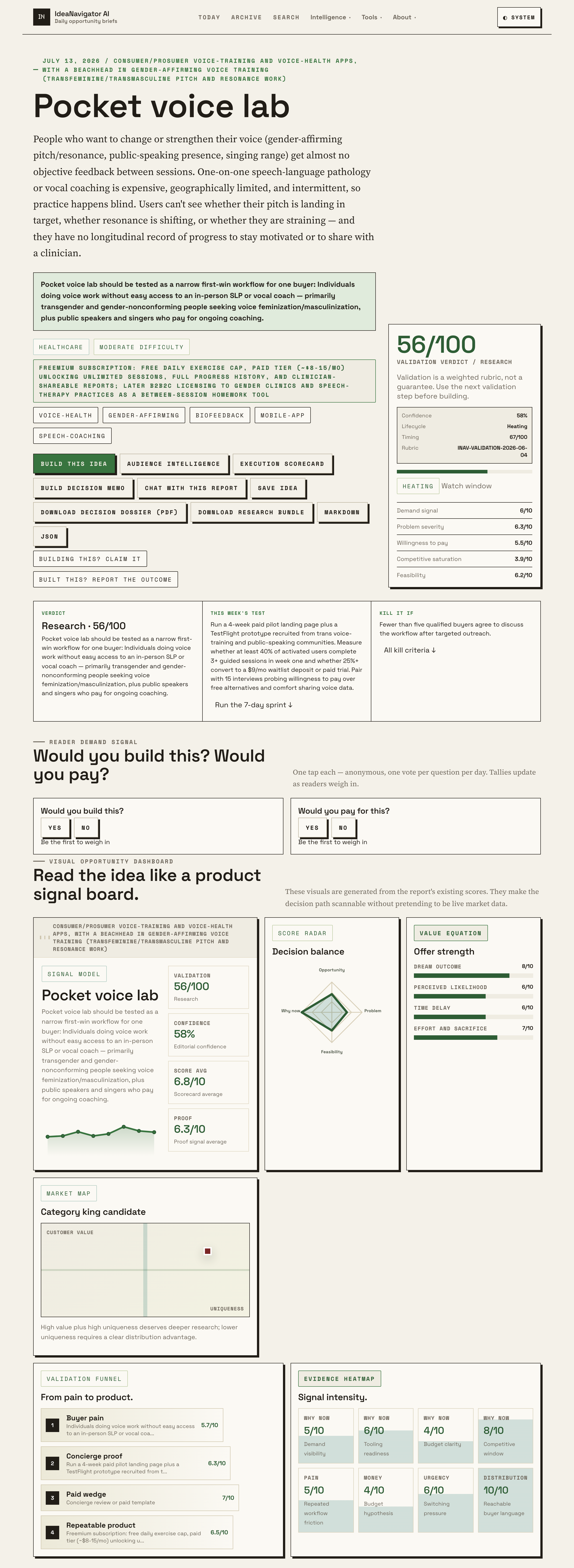
Pocket Voice Lab is a proposed mobile app that would give users visual feedback on pitch and resonance during voice exercises and track practice over time. The concept has not been reported as a launched product or tested pilot; its suggested paid pilot and success measures remain plans, not results.
IdeaNavigator AI has proposed Pocket Voice Lab, a mobile app concept for people practicing voice skills without regular access to an in-person speech-language pathologist or vocal coach. The plan centers on visual feedback for pitch and resonance, guided exercises and progress tracking, but no launched app, completed pilot or clinical results are reported.
The proposed first audience is people pursuing gender-affirming voice feminization, particularly transgender and gender-nonconforming users who want feedback between appointments. Public speakers and singers are also identified as possible users, but the plan recommends beginning with one group rather than building for all of them at once. That narrower approach would let the team test whether a specific set of exercises is useful before expanding the product.
The minimum version would let a user record a short sample and receive visual feedback on fundamental pitch and resonance compared with a target they set. It would also include a basic strain indicator derived from harmonic-to-noise ratio, between eight and 12 guided exercises, a session log and summaries users could share with a clinician. IdeaNavigator AI describes these as proposed features; it does not provide performance data showing that a phone can reliably assess strain or resonance for this use.
The suggested business model is a free tier with a daily exercise limit and a subscription priced at about $8 to $15 per month for unlimited practice, full progress history and clinician-shareable reports. The proposal would first test a $9 monthly waitlist deposit or paid trial. It also outlines possible later licensing to gender clinics and speech-therapy practices, but gives no commitments from those providers.
Feedback Between Coaching Sessions
The concept addresses a practical gap identified in the proposal: one-to-one coaching and speech-language pathology can be expensive, geographically limited and intermittent, leaving some people to practice without objective feedback between visits. If the app’s measures prove useful, a record of sessions could help users follow changes over time and give a clinician material to review. That could make home practice more structured, though the proposal does not establish that app feedback can replace professional assessment.
The focus on gender-affirming voice work makes the product’s scope especially consequential for users seeking changes in pitch and resonance. Those goals are individual, and a single target or score may not capture whether a person feels comfortable or is using their voice safely. The proposed strain indicator could be relevant to users trying to avoid overexertion, but its accuracy and limits would need testing before users rely on it. The app’s value therefore depends not only on attracting users, but on presenting acoustic measures carefully and making clear what they can and cannot tell someone.
The proposal also frames the idea as a consumer subscription opportunity, while suggesting that clinician sharing could support its use alongside care. Those are different tests: people may try an app without paying for it, and a user’s willingness to share recordings does not show that clinicians will adopt its reports. The proposed pilot would need to examine both continued use and comfort with voice-data sharing before the business case is clear.
As an affiliate, we earn on qualifying purchases.
A Narrow Start for Voice Training
IdeaNavigator AI points to smartphone microphones and on-device pitch and formant analysis as reasons a phone-based tool may now be practical without laboratory equipment. It also cites research treating acoustic measures such as pitch, jitter, shimmer and harmonic-to-noise ratio as potential voice-health or clinical signals. The proposal names academic prototypes TruVox and Attuned as examples of work in the area, but provides no study details, measurements or links that would establish how their results compare with the proposed app.
For consumer demand, the proposal cites Vocal Image and reports it has more than 4 million downloads. That figure is presented as a download count, not a measure of paid subscribers, retention or outcomes for gender-affirming voice practice. It may indicate interest in voice-feedback apps broadly, but does not establish demand for Pocket Voice Lab or for its proposed price.
The recommended test is a four-week paid pilot using a landing page and a TestFlight prototype, recruited through trans voice-training and public-speaking communities. The initial focus is gender-affirming feminization work; the proposal says to defer a broader set of user groups and accent-focused features until the first audience shows sustained use. No pilot recruitment, participant count or findings are reported.
As an affiliate, we earn on qualifying purchases.
Accuracy, Safety and Demand
No product or trial results are reported. It is unclear whether Pocket Voice Lab has a development team, a working prototype, a release timeline or partnerships with clinicians. The proposed conversion targets—at least 40% of activated users completing three or more guided sessions in their first week, and at least 25% placing a $9 deposit or entering a paid trial—are validation goals, not achieved results.
The proposal does not explain how the app would calculate resonance or strain, how accurate those readings would be across different voices and phones, or how it would respond when a measure is uncertain. It also does not describe privacy protections, storage or deletion policies for recordings, or the terms under which users would share reports. These questions matter because voice samples are personal data, while automated indicators could be mistaken for clinical judgments.
It is also unknown whether users would pay when free alternatives are available, whether a subscription would retain them after an initial training period, and whether speech-language pathologists would find the reports useful. The suggested interviews are intended to probe willingness to pay and comfort sharing voice data, but no interview results are given.
As an affiliate, we earn on qualifying purchases.
The Proposed Four-Week Test
The next step outlined in the proposal is a four-week paid pilot, supported by a landing page and a TestFlight prototype. Recruitment would target trans voice-training and public-speaking communities. The team would track whether users complete at least three guided sessions during their first week and whether a quarter or more make a $9 deposit or begin a paid trial.
The proposal also calls for 15 interviews about payment preferences, free alternatives and willingness to share voice recordings. Those interviews could surface privacy concerns and show whether users see clinician-shareable progress reports as useful. No start date, recruitment announcement or prototype availability is provided, so it is not clear when—or whether—the test will take place.
If a pilot proceeds, its results would help determine whether to keep the app focused on gender-affirming feminization practice, adjust its feedback and pricing, or consider wider audiences. Any clinical use would require clear evidence about the limits and reliability of its measurements; the proposed concept alone does not establish that the app can safely assess voice strain or guide therapy.
Source: IdeaNavigator AI
As an affiliate, we earn on qualifying purchases.
Key Questions
Is Pocket Voice Lab available now?
No availability is reported. The material describes a proposed product and pilot, not a launched app or public download.
Who is the proposed app for?
The initial audience would be people practicing gender-affirming voice feminization without easy access to an in-person coach or speech-language pathologist. Public speakers and singers are mentioned as possible later audiences.
What feedback would it provide?
The proposed app would show visual feedback on pitch and resonance against a user-set target, offer guided exercises and log progress. A basic strain indicator based on harmonic-to-noise ratio is also proposed, but its accuracy has not been reported.
Has the app been clinically validated?
No validation results for Pocket Voice Lab are provided. The proposal cites voice-analysis research and other training prototypes as context, but those references do not establish the accuracy or clinical value of this specific app.
How would the proposal test whether people will pay?
It suggests a four-week pilot and a $9 monthly deposit or paid-trial test, alongside interviews about willingness to pay and voice-data sharing. The conversion and session-completion figures are proposed targets, not results.
Source: IdeaNavigator AI
Fall Picks
fall essentials
As an affiliate, we earn on qualifying purchases.