
To create immersive media with spatial audio, you should focus on techniques like binaural rendering and ambisonic decoding. Binaural methods use digital algorithms or microphones to mimic how human ears perceive sound, offering a realistic experience through headphones. Ambisonic decoding captures full 3D sound fields, ideal for VR and multi-speaker setups. By mastering these techniques, you’ll craft convincing soundscapes, making your media truly immersive. Keep exploring to open more secrets for enhancing spatial perception.
Key Takeaways
- Utilize binaural rendering to simulate natural 3D sound perception through headphones for personalized immersive experiences.
- Implement ambisonic decoding to capture and manipulate full-sphere sound fields suitable for VR and multi-channel speaker setups.
- Apply advanced signal processing algorithms to accurately position and level sound sources, enhancing spatial realism.
- Combine head-tracking with spatial audio techniques to enable dynamic sound movement aligned with user movements.
- Optimize mix levels and placement of audio elements to create convincing, immersive soundscapes that engage the audience.
Spatial audio mixing techniques have revolutionized the way you experience sound by creating a more immersive and realistic listening environment. Whether you’re listening through headphones or speakers, these methods allow you to perceive sound sources as if they exist around you in three-dimensional space. Two key techniques that enable this are binaural rendering and ambisonic decoding. Binaural rendering uses two microphones placed inside a dummy head or employs digital algorithms to simulate how human ears perceive sound, capturing subtle cues like timing and intensity differences. When you listen to binaurally rendered audio through headphones, it tricks your brain into localizing sounds with remarkable accuracy, making you feel as though voices or instruments are coming from specific directions.
Ambisonic decoding, on the other hand, involves capturing sound in a full-sphere format that encompasses height, depth, and azimuth. It records sound with multiple channels arranged in a way that represents the entire 3D sound field. When you decode ambisonic recordings, you can manipulate the spatial information to create a dynamic and immersive experience. This technique is especially effective in virtual reality environments or large-scale installations, where you want the sound to respond to your head movements and position. By decoding ambisonic signals appropriately, you give your audience the ability to move and still feel enveloped in the soundscape, enhancing realism and engagement.
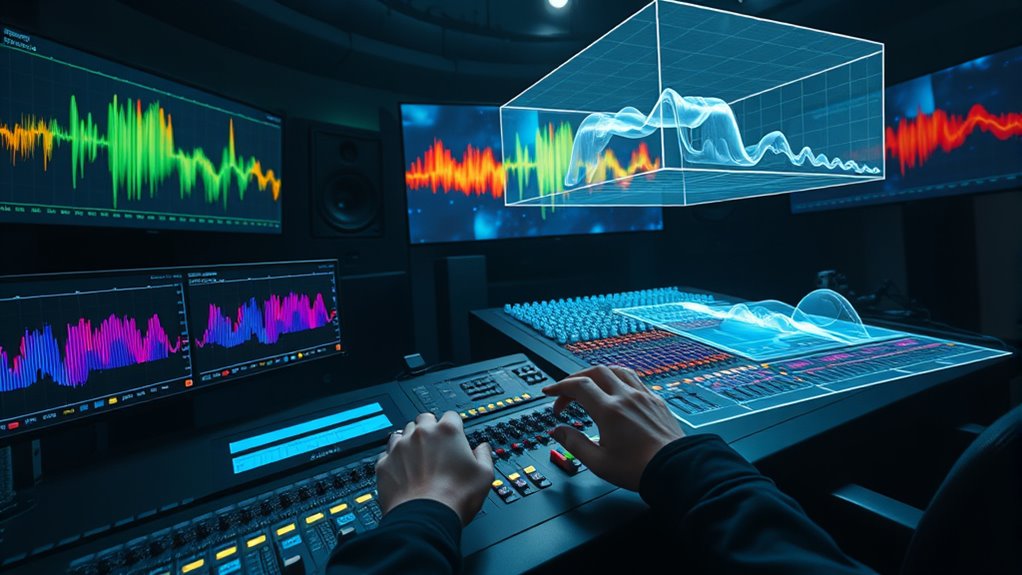
Both binaural rendering and ambisonic decoding are grounded in complex signal processing algorithms, but their end goal is simple: to produce a natural and convincing sense of space. Binaural rendering excels in personal listening scenarios, such as headphones, because it directly mimics the way your ears perceive sound in real life. Ambisonic decoding shines in multi-channel speaker setups or VR environments, where spatial information can be manipulated in real-time to match your movements and orientation. When mixing audio with these techniques, you need to pay close attention to the placement and level of each sound source, ensuring they interact convincingly within the three-dimensional space.
Binaural and ambisonic techniques create convincing 3D soundscapes for headphones and immersive environments.
Mastering these techniques requires understanding how sound interacts with human perception, and how to encode spatial cues effectively. By leveraging binaural rendering and ambisonic decoding, you can craft audio experiences that are not just heard but felt, transporting your audience into a truly immersive world. Whether you’re designing for headphones, speakers, or virtual environments, these methods bring a new level of realism and engagement that transforms how sound is experienced in media.
Top picks for "spatial audio techniqu"
Open Amazon search results for this keyword.
As an affiliate, we earn on qualifying purchases.
Frequently Asked Questions
How Does Head-Tracking Impact Spatial Audio Accuracy?
Head tracking considerably boosts spatial audio accuracy by aligning sound sources with your head movements, enhancing spatial perception. When your head-tracking accuracy is high, you experience more precise sound localization, making immersive media feel more real. Without responsive head tracking, sounds can seem misplaced or static, reducing immersion. As a result, good head-tracking technology ensures your audio environment adapts seamlessly, giving you a richer, more natural spatial experience.
What Are the Best Tools for Real-Time 3D Audio Mixing?
Imagine elevating your audio game effortlessly. For real-time 3D audio mixing, you’ll find Ambisonic plugins like IEM Plugin Suite or Facebook’s 3D Audio SDK invaluable, offering seamless spatial sound control. Binaural rendering tools such as DearVR or Waves Nx deliver immersive experiences with head-tracking compatibility. These tools enable intuitive, accurate spatial placement, ensuring your immersive media sounds compelling and precise, even during live sessions.
How Can Spatial Audio Be Optimized for Various Headphones?
To optimize spatial audio for various headphones, you should focus on headphone calibration and soundstage enhancement. Start by calibrating the audio to match each headphone’s unique response, ensuring accurate spatial cues. Use software that adapts sound positioning, enhancing the soundstage to create a more immersive experience. Regularly test across different headphones, making adjustments as needed to maintain consistent quality and spatial accuracy for every user.
What Challenges Exist in Integrating Spatial Audio Into Live Broadcasts?
You’ll face challenges like latency issues and hardware compatibility when integrating spatial audio into live broadcasts. Latency can cause audio delays, disrupting the immersive experience, so you need optimized processing to keep synchronization tight. Hardware compatibility also poses problems, as different devices may not support advanced spatial audio features. To succeed, you must select versatile equipment and implement real-time processing solutions that minimize delay and guarantee seamless integration.
How Does Room Acoustics Influence Spatial Audio Perception?
Room acoustics markedly influence how you perceive spatial audio. Reverberation effects from the room can blur sound localization, making it harder to pinpoint sources accurately. Proper room calibration helps control these reverberation effects, ensuring cleaner, more precise spatial cues. By adjusting for room acoustics, you enhance immersion and clarity, allowing you to experience a more authentic sense of space and direction in immersive media.
Conclusion
Mastering spatial audio mixing techniques allows you to create truly immersive experiences. By carefully positioning sounds and leveraging the right tools, you bring media to life with depth and realism. Remember, “a picture is worth a thousand words,” and in audio, spatial precision speaks volumes. Keep experimenting, stay attentive to detail, and your audience will feel transported to another world, proving that in immersive media, the devil is in the details.