
TL;DR

Get everyday helpers delivered free with Prime
- Fast, free delivery on millions of items
- Prime Video, Amazon Music and more included
- Member-only deals all year
Mistral is shifting from a model developer to a full-stack, sovereignty-focused AI provider. Critics say it might be falling behind in reasoning and scale, but its enterprise and European market niche could give it a different kind of advantage.
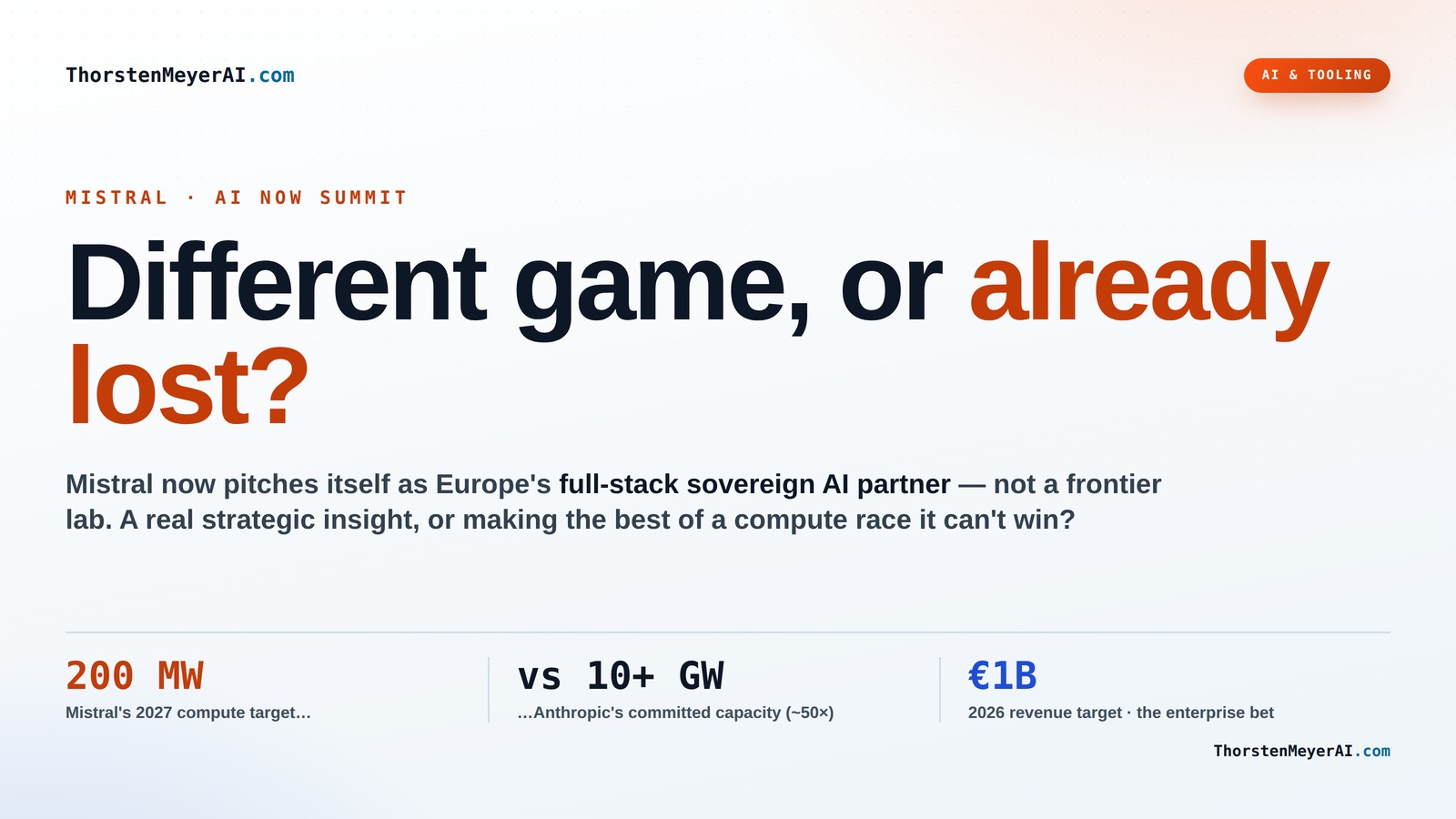
Different game, or already lost?
Mistral now pitches itself as Europe’s full-stack AI provider — compute, models, platform, consultancy — not a frontier-model lab. Is that a real strategic insight, or making the best of a race it can’t win? Both readings fit the same facts.
From model lab to full-stack provider
The clearest signal from the summit wasn’t a model — it was a posture. Heavy on enterprise logos and partnerships (ASML, BNP Paribas, Alexa+), light on new-model announcements. That absence is exactly what skeptics seized on.
Compute
40MW Paris DC + Sweden build · 200MW target by 2027
Models
Open & custom · efficient · you own and run them
Platform
Forge for custom models · Vibe for Work agent
Consultancy
Sales teams, integrators, EU provenance & support
Small & focused, or large & general?
Mistral bets on specialized small models. The claim isn’t that they win a reasoning leaderboard — they don’t. It’s that on the metrics that matter in production agent systems, a purpose-built small model wins. Flip the metric to see the case reverse.
Small specialized vs large general — by what you measure
In token-heavy agentic apps making hundreds of calls, speed/energy/cost compound. Toggle the metric.
Narrow models doing real work
Each is one model doing one thing efficiently — the tangible version of the strategy. Strong on their own terms; the open question is whether the bundle beats a free Chinese open-weight download.
On-prem KYC compliance
Mistral models run inside the bank’s walls for know-your-customer checks. Sensitive financial data never leaves. (BNP was Mistral’s first customer, 2023.)
Voxtral multilingual voice
A focused voice model powering Alexa+ across Europe — speed and efficiency over raw size.
Robostral industrial robotics
Plus a “physics AI” push (via the Emmi acquisition) into aerospace, automotive & semiconductor design and simulation.
Document AI / OCR at scale
Large-scale text extraction — the unglamorous, high-volume enterprise work small models excel at.
The strategy is downstream of the compute gap
Once you see the raw numbers, “why is Mistral behind?” answers itself — and the specialized-small-model strategy starts looking partly like a smart adaptation to a binding constraint, not a pure philosophical choice.
Compute & capital · Mistral vs a frontier leader, this same week
Not a knock — it’s the constraint that forces the efficiency-first, sovereignty-wedge strategy. Adapting intelligently to your position is what good strategy is.
“I want them to win, but I’m worried”
That ambivalence is the most accurate read of where Mistral sits. The enterprise pivot gets read two opposite ways — and both deserve airing.
On-prem, real sales teams, the Koyeb deployment acquisition, EU provenance — exactly what regulated enterprises want, and stickier than consumer mindshare. Targeting €1B revenue in 2026 with 1,000 staff, up from 15 people and one customer in 2023. US closed-API labs structurally can’t match the sovereignty axis.
“Software consultancy with a data center,” not a foundation-model moat. Enterprise B2B is where European startups go when they can’t win consumer or world-scale SaaS. Why pay Mistral on-prem when you could run Qwen free? One paying Le Chat Pro user said the quality gap with frontier labs is now hard to ignore.
Key Takeaways
- Mistral is shifting from model innovation to full-stack, sovereignty-focused solutions, targeting regulated European markets.
- Open weights and local deployment offer a strong appeal for compliance-heavy industries, but question their cost-effectiveness versus free open models.
- Small, purpose-built models excel in specific, high-volume enterprise tasks, but may limit future AI capabilities.
- Recent benchmarks suggest Mistral’s models lag in reasoning and medium-context tasks, raising doubts about its competitiveness in the frontier race.
- European sovereignty and control are strategic priorities that shape Mistral’s niche, but whether this can translate into global leadership remains uncertain.
As an affiliate, we earn on qualifying purchases.
Why Mistral’s Sovereignty Push Changes the AI Game
Mistral’s focus isn’t just on building models; it’s on controlling the entire AI stack. Think of it as owning the roads, cars, and fuel—rather than just designing the fastest vehicle. This approach appeals to governments and banks that need their data and models to stay inside their walls. Their European data centers, partnerships with big names, and open weights give them a unique edge in these markets.
For example, BNP Paribas runs Mistral models on-prem for sensitive financial tasks, keeping data in-house. That’s a clear win for regulated industries worried about compliance. But critics ask: if you want on-prem, why pay Mistral when you can just run a free open-weight model like Qwen? The real question: does Mistral’s support, localization, and custom platform justify the cost?
Deeply, this strategy emphasizes control over AI assets, which can be crucial in sectors where data privacy and regulatory compliance are non-negotiable. However, this control comes with tradeoffs—namely, potentially sacrificing access to the rapid innovations and economies of scale enjoyed by cloud-based giants. The implication is that Mistral is betting that the value of sovereignty and customization outweighs the performance and cost benefits of centralized, large-scale models. This shifts the competitive landscape from performance-driven to control-driven, meaning success hinges on how well they can demonstrate that their localized, secure approach can meet or exceed enterprise needs without the raw power of the largest models.

As an affiliate, we earn on qualifying purchases.
Is Mistral Playing a Different Game Than US Giants?
Mistral’s strategy is about control, not just raw power. Unlike OpenAI or Google, which focus on massive models and API-based access, Mistral aims to give companies the tools to own and run models themselves. This is a game of decentralization, customization, and compliance. They want to be the trusted partner for Europe’s regulated sectors.
But does this mean they’re falling behind in reasoning or speed? Critics say yes, especially since recent benchmarks show their models lag in complex reasoning and medium-context tasks. This performance gap is significant because it touches on the core of AI’s evolution—models that can understand and generate nuanced, context-aware responses are increasingly vital for advanced applications. If the main advantage of frontier models is their reasoning prowess, then Mistral’s focus on control and local deployment might mean they are ceding ground in the most cutting-edge areas. The tradeoff is clear: they prioritize reliability, compliance, and sovereignty over pushing the boundaries of AI reasoning. The implication is that their game is less about leading the race in raw AI capability and more about securing a niche where control and trust matter more than the latest breakthroughs. Whether this strategic choice pays off depends on how much value enterprises place on sovereignty versus raw AI power.

As an affiliate, we earn on qualifying purchases.
Small Models, Big Impact: Why focus on purpose-built AI makes sense
Mistral champions small, specialized models over giant, general-purpose ones. Think of these as sharp knives rather than broad swords. Each is optimized for specific tasks—OCR, voice in Europe, industrial robotics—and does them efficiently. They claim these models are faster, cheaper, and more energy-efficient, which matters in high-volume applications.
For example, their document AI used by the European Patent Office extracts large texts quickly, saving time and resources. This narrow focus helps them beat bigger models on practical metrics, even if not on reasoning benchmarks.
Deeply, this strategic choice reflects an understanding that in many enterprise and industrial contexts, specialized tools outperform general-purpose giants. By honing in on specific tasks, Mistral reduces complexity, improves reliability, and lowers costs—factors that are often more critical for business adoption than pushing the limits of AI reasoning. However, this approach also implies a potential limitation: as AI technology advances, the value of broad, general intelligence models grows. Their narrow focus might make it harder to pivot toward more generalized AI capabilities in the future. The tradeoff is between immediate, measurable wins in niche applications and long-term potential in broader AI innovation. This strategic emphasis on purpose-built models indicates a clear understanding of market needs but also highlights a risk: their future relevance depends on how well they can evolve these specialized models into more versatile solutions.

AI compute infrastructure for businesses
As an affiliate, we earn on qualifying purchases.
As an affiliate, we earn on qualifying purchases.
The Real Test: Can Sovereignty and Openness Beat Benchmark Power?
The core debate: is Mistral’s sovereignty-focused, open-weight approach enough to stay relevant? On one side, European regulators, defense agencies, and banks want control and compliance. On the other, critics point out that their models may lag in reasoning, speed, and context length—key factors for cutting-edge AI.
Recent chatter suggests Mistral has fallen behind since mid-2025, especially in reasoning benchmarks. This decline could be a sign that their model architecture and training data aren’t keeping pace with the rapid innovations seen in US and Chinese labs. For enterprises, this raises a critical question: is the tradeoff worth it? If the core advantage of frontier models is their ability to process longer contexts, reason more deeply, and adapt quickly, then lagging in these areas could mean losing competitive edge in high-stakes applications. The strategic implication is that sovereignty and openness are not inherently enough to secure leadership; they must be complemented by performance. If Mistral cannot bridge the gap in reasoning and scalability, their niche might become more about compliance and control than technological leadership, risking obsolescence in the fast-evolving AI landscape. The key takeaway is that the sustainability of their approach depends on their ability to innovate within their constraints—otherwise, they risk falling further behind.

Europe’s AI Independence vs Global AI Dominance
Europe’s push for AI sovereignty isn’t just about Mistral. It’s part of a broader movement to reduce dependency on US and Chinese tech giants. Think of it as building a fortress—less about winning every battle, more about control and security.
For example, Mistral’s open weights and local deployment options appeal to countries wary of data leaks or foreign influence. But this strategy can limit their scale and access to cutting-edge breakthroughs happening in US labs.
Deeply, this strategic choice reflects a tension between sovereignty and innovation. While local control enhances security and compliance, it may also hinder access to the latest research and large-scale training resources that only the biggest US and Chinese labs can afford. This tradeoff could slow down their technological progress, making it harder to keep pace with global leaders. The implication is that European AI ambitions, embodied by Mistral’s approach, might prioritize strategic autonomy over rapid technological advancement. Whether this is sustainable depends on how well they can leverage local advantages without falling behind in core AI capabilities. Ultimately, their success hinges on balancing sovereignty with the need to stay at the forefront of AI innovation—a challenging but crucial equation.

What Does All This Mean for You and Your Business?
If you’re running a regulated enterprise, Mistral’s model might be exactly what you need—control, compliance, local deployment. But if you’re after the best reasoning or fastest development, bigger labs might still rule.
Consider your priorities: data security? Customization? Cost? The choice isn’t just about tech—it's about what matters most to your organization.
For example, a European bank might prefer Mistral’s on-prem models for compliance, while a startup aiming for rapid innovation might lean toward OpenAI’s API. It’s all about matching your needs to their strengths.
Deeply, this decision reflects a fundamental tradeoff: prioritizing sovereignty and control may limit access to the latest AI breakthroughs, potentially impacting your competitive edge. Conversely, opting for more open, cloud-based solutions might offer superior performance and scalability but at the expense of data sovereignty. The key is understanding which factors—security, speed, cost, or innovation—are most critical for your strategic objectives. Your choice will shape not only your AI capabilities but also your compliance posture and long-term flexibility in a rapidly evolving landscape.

Frequently Asked Questions
What exactly does 'sovereign AI' mean for enterprises?
Sovereign AI means companies can deploy models locally, keep data on-prem, and avoid dependency on US or Chinese cloud providers. It’s about control, compliance, and security—key for regulated industries.Is Mistral still competitive on reasoning and scale?
Recent public benchmarks suggest Mistral models lag behind in reasoning and medium-context tasks since mid-2025. This decline could be a sign that their model architecture and training data aren’t keeping pace with the rapid innovations seen in US and Chinese labs. For enterprises, this raises a critical question: is the tradeoff worth it? If the core advantage of frontier models is their ability to process longer contexts, reason more deeply, and adapt quickly, then lagging in these areas could mean losing competitive edge in high-stakes applications. The strategic implication is that sovereignty and openness are not inherently enough to secure leadership; they must be complemented by performance. If Mistral cannot bridge the gap in reasoning and scalability, their niche might become more about compliance and control than technological leadership, risking obsolescence in the fast-evolving AI landscape. The key takeaway is that the sustainability of their approach depends on their ability to innovate within their constraints—otherwise, they risk falling further behind.Why would a European company choose Mistral over US giants?
European firms value control, data sovereignty, and compliance. Mistral’s open weights and local deployment options fit these needs, offering an alternative to API-based, US-controlled models.Can open-weight models truly be a business advantage?
For certain sectors, yes. They enable customization, compliance, and cost control. But at scale, the open weights’ quality and support are crucial to justify the switch from free alternatives.Is Mistral’s European focus limiting its global reach?
Potentially. While it’s strong in Europe, the company’s emphasis on sovereignty and open weights may restrict access to the latest AI breakthroughs, which are largely driven by US labs.Conclusion
Mistral’s story isn’t just about building better models; it’s about redefining what winning means in AI. For Europe and regulated sectors, sovereignty and control may matter more than raw performance. But in the relentless race for AI power, falling behind in reasoning could be a costly gamble. The real question: can control and openness carve out a sustainable, competitive edge or just mask a shrinking relevance?Columbus Day / Indigenous Peoples' Day Picks
long weekend sales
As an affiliate, we earn on qualifying purchases.