
TL;DR

Get everyday helpers delivered free — and shop member deals
- Fast, free delivery on millions of items
- Access to Prime Big Deal Days deals on October 6–7
- Prime Video, Amazon Music and more included
Prebuilt AI workstations now often match or beat DIY costs due to component shortages and bulk buying. They save time, offer validated thermals, and include support. Building gives control and customization but may cost more and take longer.
Imagine firing up your AI project—and it’s ready in minutes, not days. No hunting for parts, no BIOS battles, just plug and play. That’s the real shift in 2026: prebuilt AI workstations now compete directly with custom builds on price, support, and speed. The question isn’t just build or buy; it’s which option matches your workload, budget, and patience.
Whether you’re eyeing a local LLM, training models, or inference, understanding the tradeoffs helps you avoid costly mistakes. This isn’t about the old idea that DIY is always cheaper—it’s about what makes sense today, with supply chain chaos and AI’s insatiable appetite for power and cooling.
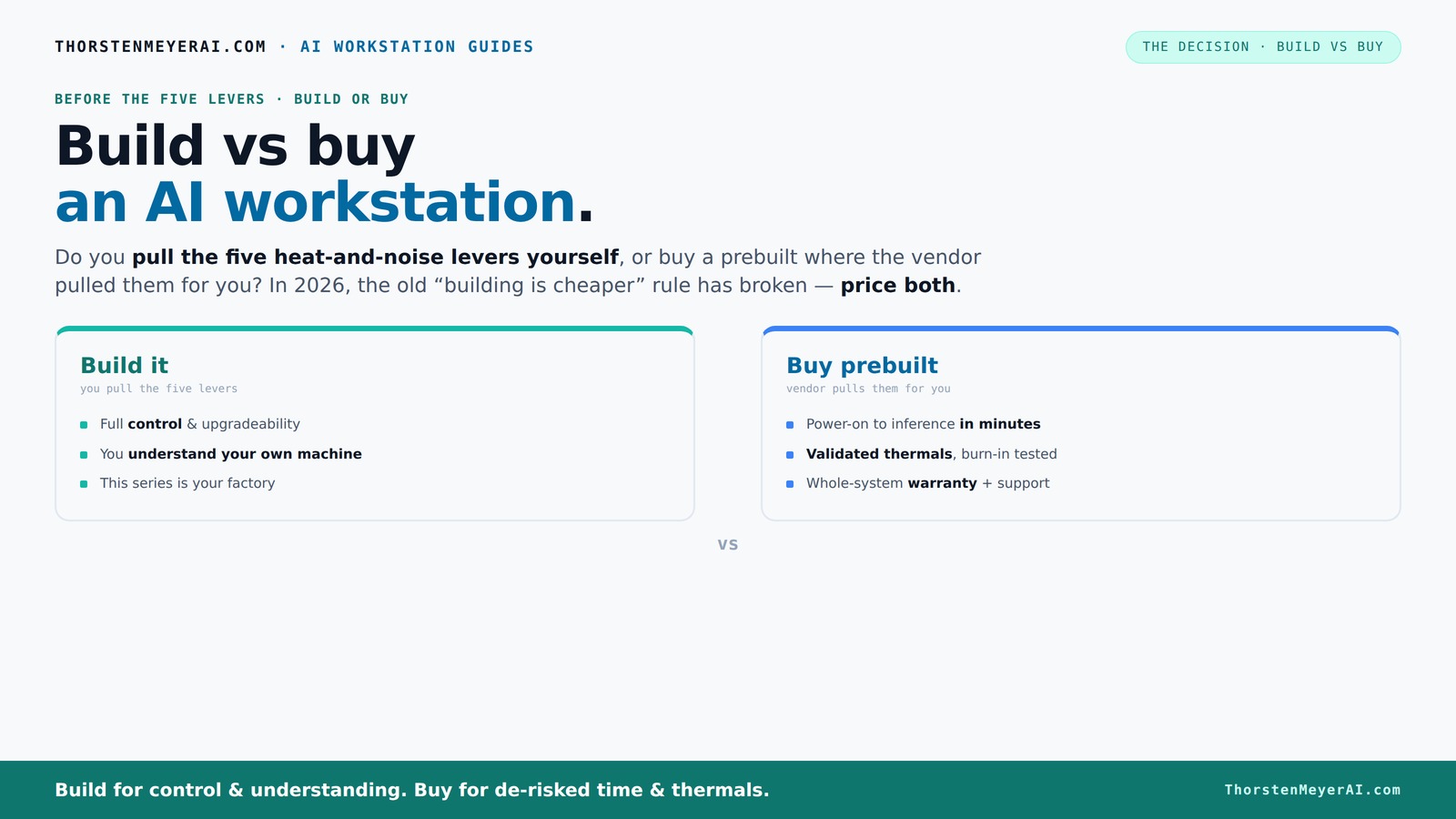
Build vs buy
an AI workstation.
The real question behind this whole series: do you pull the five heat-and-noise levers yourself, or buy a prebuilt where the vendor pulled them for you? And in 2026, the old “building is cheaper” rule has broken. Match your situation in Part 3.
Key Takeaways
- Component shortages in 2026 make prebuilt AI workstations often just as affordable as DIY, so always compare prices today.
- Prebuilts save you hours of setup, testing, and troubleshooting, offering validated thermals and warranties.
- Choosing the right GPU and thermal management is critical—prebuilts come tuned, DIY requires hands-on tuning.
- Support and upgradeability are major factors—prebuilts often include comprehensive support, while DIY offers more flexibility. Explore build vs buy options.
- A hybrid approach can give you the best of both worlds: buy a reliable system and upgrade later.
As an affiliate, we earn on qualifying purchases.
Why 2026 Changes Everything in the Build vs Buy Debate
Building a PC used to be the clear winner for cost. But in 2026, shortages and bulk buying have flipped the script. Prices for GPUs, DDR5 RAM, and SSDs have surged—sometimes up to 30% since last year. Build vs Buy a Prebuilt AI Workstation. Meanwhile, prebuilt vendors pre-purchased components in bulk, allowing them to offer systems at prices that are often impossible to match yourself.
For example, a high-end AI workstation with a 4090 GPU, 128GB RAM, and fast NVMe SSDs used to cost around $3,000 to build. Today, a reputable prebuilt can match that price, with the added benefits of testing, thermal tuning, and warranty. That’s a game changer. It means you need to compare actual prices today, not rely on past assumptions.
Beyond cost, this shift impacts how quickly you can get started. Prebuilts reduce lead times significantly, especially when component availability is unpredictable. It also shifts the decision from a purely financial one to a strategic choice about risk, support, and future flexibility. Build vs Buy a Prebuilt AI Workstation. If you value reliability and speed of deployment, prebuilt systems become increasingly attractive, even if you initially thought DIY was cheaper.
As an affiliate, we earn on qualifying purchases.
The Heat and Noise Battle: Who Pulls the Levers?
Running AI workloads at full throttle turns your workstation into a furnace. Managing heat and noise involves five levers: undervolting, matching coolers, optimizing airflow, tuning fans, and placement. Learn more about cooling and thermal management. When you buy prebuilt, the vendor’s team pulls these levers—testing and validating the setup before shipping.
Some vendors like Lambda promise systems that run up to 30% cooler and quieter—thanks to factory tuning and water-cooling. This is critical because thermal management directly affects performance and longevity. Overheating can cause thermal throttling, reducing your GPU’s effective performance, and can even damage components over time.
Building your system allows you to choose your cooling solutions—air, water, or hybrid—giving you control over noise levels and thermals. However, this requires understanding airflow dynamics, thermal paste application, and fan curves. Poor thermal management can lead to frequent crashes, reduced hardware lifespan, and increased noise. The tradeoff is between convenience and precision: prebuilt vendors handle the complex tuning, while DIY builders must develop their expertise, which can be the difference between a stable, quiet system and one that’s loud and unreliable under load.
As an affiliate, we earn on qualifying purchases.
Cost Breakdown: Building vs Buying — What’s the Real Difference?
| Factor | Prebuilt AI Workstation |
|---|---|
| Price | Includes assembly, testing, warranty, and support. Often comparable or cheaper in 2026 due to bulk discounts and component shortages. This consolidated support reduces the risk of hidden costs from misassembly or component incompatibilities. |
| Time to deploy | Minutes to hours, since system is ready to run. DIY can take days or weeks, especially if troubleshooting issues or sourcing hard-to-find components. The quick deployment reduces downtime and accelerates your project timeline. |
| Support & warranty | Single vendor support, often with multi-year coverage, simplifying troubleshooting and repairs. DIY relies on individual component warranties and your own troubleshooting skills, which can introduce delays and uncertainty during critical phases. |
| Customization | Limited to vendor options; some allow upgrades within predefined parameters. DIY offers full control over every component, including proprietary parts, enabling highly tailored configurations but increasing complexity. |
| Upgradeability | Depends on vendor; often limited by proprietary connectors or custom parts. DIY is generally easier to upgrade, provided you select standard, modular components from the start, facilitating future enhancements without obsolescence concerns. |
In 2026, the actual purchase price for a high-end system can be similar for both options, but the real difference lies in support, time, and flexibility. Learn more about cloud solutions for AI. Choosing a prebuilt reduces risk and accelerates deployment, but building offers unmatched customization and upgrade potential for those willing to invest the time and expertise.
professional AI workstation support
As an affiliate, we earn on qualifying purchases.
As an affiliate, we earn on qualifying purchases.
Frequently Asked Questions
Is a prebuilt AI workstation worth it?
Yes, if you value quick deployment, support, and proven thermal performance. Prebuilts are tested, come with warranties, and save you hours or days of setup. For most professionals and small teams, they’re often the smarter choice in 2026.
Is building cheaper than buying in 2026?
Not always. Due to component shortages and bulk buying, prebuilt systems can match or beat DIY prices today. Always compare actual prices for your specific configuration before deciding.
Which is better for local LLMs and inference?
Both options work, but prebuilts often come with validated cooling and power delivery—reducing setup risks. Building offers customization if you need specific GPUs or cooling solutions.
How much RAM and what GPU do I need?
For inference, 64GB RAM and a high-end GPU like a 4090 are common. For training large models, consider 128GB RAM and multiple GPUs. Check your workload and pick a system that’s balanced and future-proof.
Will I be able to upgrade the GPU later?
Depends on the system. Prebuilts may limit upgrades with proprietary connectors or limited space. Building allows easier upgrades, provided you choose standard parts and a flexible motherboard.
Conclusion
Deciding between building or buying your AI workstation in 2026 isn’t just about cost. It’s about what you value—speed, support, control, or flexibility. If you need a reliable, ready-to-run system, a prebuilt might save you weeks of hassle. But if customization and upgrade paths matter most, building keeps you in the driver’s seat.
Remember, the market has shifted. Today, it’s not just about DIY saving dollars—it’s about matching your workload and resources. Choose smart, and your AI setup will be a powerhouse that fits your needs, now and tomorrow.
Halloween Picks
halloween
As an affiliate, we earn on qualifying purchases.