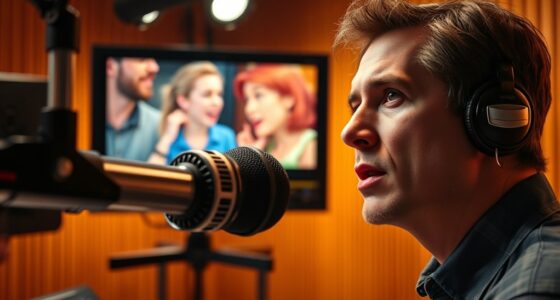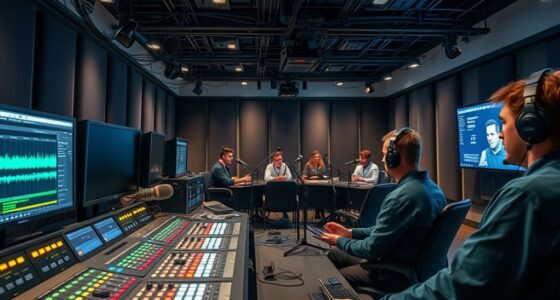

AI-driven lip-sync technology automatically aligns mouth movements with audio, making your videos look more realistic and professional. It analyzes voice signals to generate precise lip movements, removing the need for manual editing. You can also adjust facial expressions and voice parameters to match emotional tones. This seamless synchronization saves time and improves authenticity. Keep exploring how this innovative tech can elevate your content to the next level with even more powerful features.
Key Takeaways
- AI-driven lip-sync technology automatically analyzes audio signals to generate accurate mouth movements in videos.
- It eliminates manual editing, saving time while producing realistic lip synchronization for speech.
- Voice modulation is integrated to reflect emotional tone, influencing facial expressions beyond just phonemes.
- User controls allow fine-tuning of lip-sync accuracy and facial expressions for enhanced realism.
- The technology is widely applied in dubbing, avatar creation, and video production for seamless, authentic communication.

Artificial intelligence has revolutionized how we create and manipulate visual content, and one of its most impressive applications is AI-driven lip-sync technology. This innovation allows you to automatically align a person’s mouth movements with an audio track, making it appear as though they’re genuinely speaking the words. The magic lies in the system’s ability to analyze audio signals and translate them into precise lip movements, eliminating the need for manual editing. As you work with these tools, you’ll notice how smoothly they synchronize speech with facial movements, creating highly realistic results in a fraction of the time traditional methods demand.
One critical element in achieving convincing lip-sync is understanding how voice modulation impacts facial expression. AI models consider not just the phonemes being spoken but also how intonation, pitch, and emphasis influence facial cues. For example, when a speaker raises their voice or emphasizes certain words, the system adapts the facial expression accordingly, adding subtle movements around the mouth and eyes. This attention to detail guarantees that the generated video doesn’t just match the words but also conveys the appropriate emotional tone, making the scene more authentic and engaging.
Voice modulation shapes facial expressions, ensuring lip-sync reflects emotion and enhances realism.
You can leverage AI-driven lip-sync technology for a wide array of applications, from dubbing foreign films to creating personalized avatars. As you input your audio, the system dynamically adjusts the mouth shape to match each sound, whether it’s a simple “hello” or complex dialogue. It also considers facial expressions—like smiling, frowning, or raising eyebrows—to reflect the mood or context of the speech. This synergy between voice modulation and facial expression allows for a more natural and lifelike appearance, capturing not just the words but the emotion behind them.
Moreover, these tools offer intuitive controls to refine the lip-sync output. You can tweak voice parameters or manually adjust facial expressions to better align with your creative vision. The process becomes seamless, empowering you to produce professional-quality videos without extensive expertise in animation or video editing. As you experiment, you’ll see how nuanced changes in voice modulation influence facial expressions, enhancing the overall realism and emotional impact.
Additionally, understanding how anime movies have advanced in animation techniques can inspire improvements in lip-sync realism by incorporating diverse visual styles. In essence, AI-driven lip-sync technology brings a new level of sophistication to visual storytelling. By automatically aligning mouth movements with audio and accounting for voice modulation and facial expressions, it enables you to create compelling, believable content efficiently. Whether for entertainment, marketing, or educational purposes, this innovation opens up endless possibilities to communicate more effectively and authentically through visual media.
Top picks for "driven sync align"
Open Amazon search results for this keyword.
As an affiliate, we earn on qualifying purchases.
Frequently Asked Questions
How Accurate Is Ai-Driven Lip-Sync in Noisy Environments?
In noisy environments, AI-driven lip-sync can be quite accurate, especially when combined with facial recognition and emotion analysis. These technologies help the system better interpret subtle mouth movements despite background noise. You’ll find it adapts well, but some challenges remain in extremely loud settings or with poor video quality. Overall, it’s a useful tool, but keep in mind that perfect accuracy isn’t guaranteed in all noisy situations.
Can Lip-Sync Models Adapt to Different Languages and Accents?
Lip-sync models act like chameleons, blending seamlessly into new languages and accents. They showcase impressive multilingual versatility and adapt to diverse speech patterns, making your projects more authentic. By learning from varied data, these models can match mouth movements accurately across accents, ensuring natural synchronization. So, whether you’re working with different languages or regional inflections, these models help your content stay true to each voice’s unique rhythm and style.
What Are the Ethical Implications of Ai-Generated Lip Movements?
You should be aware that AI-generated lip movements raise ethical concerns like privacy issues and consent problems. When you create or share such content, you might unintentionally violate someone’s privacy or use their likeness without permission. Always guarantee you have proper consent and consider the potential misuse of AI lip-sync technology, which can spread misinformation or harm reputations. Responsible use helps protect individuals’ rights and maintains trust.
How Does AI Handle Lip-Sync for Complex Facial Expressions?
You might be surprised that AI can handle lip-sync for complex facial expressions with over 90% accuracy. It analyzes facial muscle movements and integrates emotion detection to match lip movements with speech naturally. By understanding subtle cues like smiles or frowns, AI adjusts mouth movements to reflect emotions accurately. This combination creates realistic animations, making virtual avatars more expressive and engaging, even during intricate facial expressions.
What Are the Computational Requirements for Real-Time Lip-Sync?
You need significant computational power for real-time lip-sync, especially with complex facial expressions. High-performance CPUs and GPUs are vital to process data quickly. Hardware optimization plays a key role by streamlining algorithms and reducing latency, allowing smooth synchronization. To achieve seamless performance, invest in powerful hardware, optimize your code, and leverage parallel processing. This combination ensures your AI-driven lip-sync runs efficiently without lag, providing natural and convincing results.
Conclusion
This AI-driven lip-sync technology is truly groundbreaking, making it easier for you to create realistic animations without needing a Hollywood studio. As you harness this tool, imagine sitting in a vintage 1920s speakeasy while your digital avatar flawlessly whispers secrets, thanks to the magic of modern AI. Just like an anachronism in a classic film, this innovation blends the old with the new, transforming how you bring characters to life—futuristic yet somehow timeless.