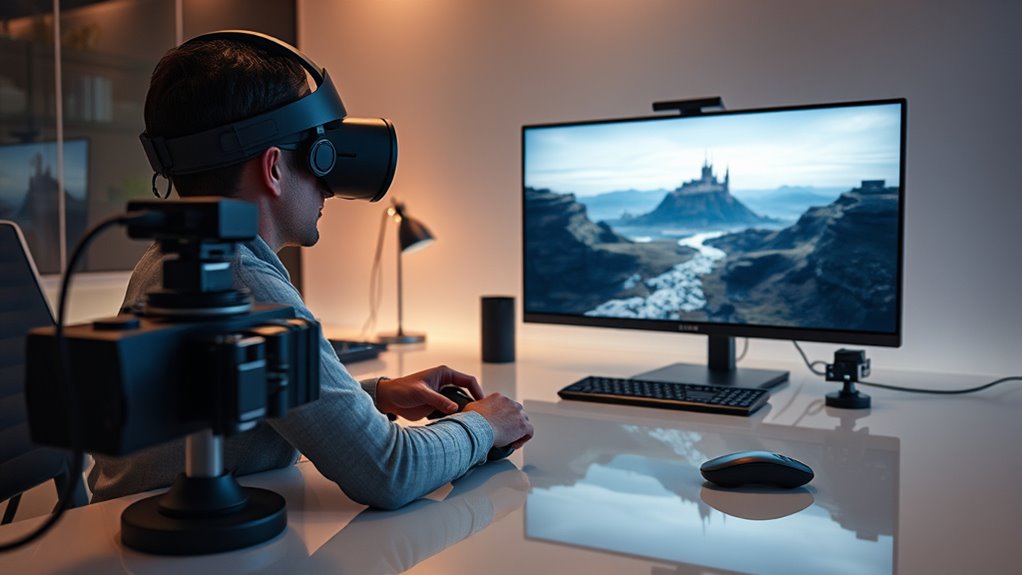

When adapting to VR and 360° narratives, focus on optimizing visuals and audio to guarantee smooth performance and prevent motion sickness or fatigue. Balance high-quality graphics with high frame rates, and reduce lag to keep immersion seamless. Test various hardware setups to find the right mix of responsiveness and visual fidelity. By paying attention to these performance factors, you can create engaging experiences—if you continue exploring, you’ll discover key strategies for success.
Key Takeaways
- Optimize visuals and audio to maintain high frame rates and prevent motion sickness.
- Test hardware configurations to balance visual quality with responsiveness.
- Use efficient assets and compression techniques to reduce rendering load.
- Design intuitive navigation and interaction to minimize user disorientation and lag.
- Continuously monitor performance metrics during development for seamless immersive experiences.
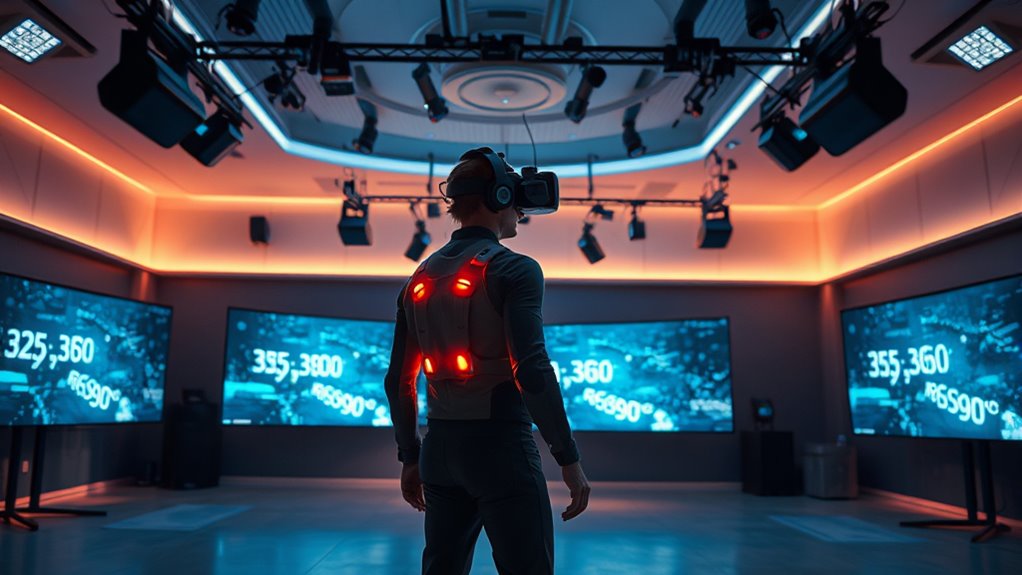
Have you ever wondered how storytelling transforms when you step into a fully immersive environment? In virtual reality and 360° narratives, you become an active participant rather than a passive viewer. This shift markedly enhances user engagement, making stories feel more personal and immediate. When you’re inside an immersive storytelling experience, every detail, sound, and visual element is designed to draw you in, encouraging you to explore and interact. Unlike traditional media, where your role is limited to watching or listening, VR invites you to become part of the narrative fabric. This heightened engagement is what makes immersive storytelling so powerful—it creates an emotional connection that’s difficult to achieve through conventional methods.
Immersive environments turn viewers into active participants, forging deeper emotional connections through engaging storytelling.
However, adapting your performance for VR requires a different approach. You need to think about how users will navigate the environment and how their actions influence the story. Your storytelling must be adaptable enough to accommodate various paths and interactions. This means designing scenes that are not only visually compelling but also intuitive for users to explore. When you craft immersive narratives, you must consider the pacing carefully. Unlike linear stories, VR experiences often involve a non-linear flow, where viewers can look around, move, or even interact with objects. This demands a dynamic storytelling style that balances guiding the user without restricting their freedom. Your goal is to maintain narrative coherence while allowing for exploration, guaranteeing users feel both engaged and in control.
Performance considerations also come into play. You need to optimize visuals and audio to prevent motion sickness or fatigue, which can break immersion and diminish user engagement. High frame rates and smooth transitions are vital to keep the experience seamless. If your content lags or stutters, you risk pulling users out of the story, reducing the immersive power you’re trying to achieve. Additionally, consider how users’ physical movements influence the narrative. You may need to incorporate interactive elements that respond naturally to user input, reinforcing the sense of presence and agency. This requires testing different performance setups and hardware configurations to find the right balance that delivers both quality and responsiveness.
Ultimately, your success in adapting storytelling to VR hinges on understanding how users engage with the environment. Your narratives should leverage the immersive medium to deepen emotional impact and create memorable experiences. When you prioritize user engagement and optimize performance, you guarantee that your VR stories aren’t just watched—they’re lived. By focusing on these elements, you harness the full potential of VR and 360° narratives, transforming storytelling into a truly immersive journey that resonates long after the experience ends.

Meta Quest 3 512GB | VR Headset — Thirty Percent Sharper Resolution — 2X Graphical Processing Power — Virtual Reality Without Wires — Access to 40+ Games with a 3-Month Trial of Meta Horizon+ Included
NEARLY 30% LEAP IN RESOLUTION — Experience every thrill in breathtaking detail with sharp graphics and stunning 4K…
As an affiliate, we earn on qualifying purchases.
As an affiliate, we earn on qualifying purchases.
Frequently Asked Questions
How Do Latency Issues Affect Viewer Immersion in VR Stories?
Latency issues can substantially reduce your immersion in VR stories, causing noticeable delays between your actions and the visuals. This disruption may lead to motion sickness and break your focus, making it harder to stay engaged. When latency is low, your movements feel natural, and your experience remains seamless. To keep viewer engagement high and avoid discomfort, developers must optimize performance and minimize latency in VR narratives.
What Are the Best Practices for Designing User Interactions in 360° Narratives?
Master mindful, meaningful interactions by making gesture controls gentle and gaze-based interactions natural. Design deliberate, dynamic gestures that are easy to perform and recognize, avoiding over-complication. Balance between interaction and immersion ensures users don’t feel overwhelmed. Keep controls intuitive, incorporating clear cues, so viewers feel free to explore. Prioritize simplicity and consistency, creating a seamless, satisfying experience that encourages exploration without frustration in your 360° narratives.
How Can Audio Be Optimized for Spatial Awareness in VR Content?
You can optimize audio for spatial awareness in VR by using spatial audio techniques that enhance sound localization. Incorporate 3D audio sources that adjust dynamically based on the user’s head movements for immersive soundscapes. Guarantee your audio cues align accurately with visual elements, and use binaural recording or HRTF filters to create realistic spatial audio. This approach helps users intuitively interpret their environment, heightening immersion and interaction within your VR content.
What Hardware Considerations Are Critical for Seamless VR Storytelling Experiences?
You need hardware that balances comfort, performance, and clarity. Prioritize ergonomic design for extended wear, ensuring lightweight, adjustable headsets that reduce fatigue. Use content compression to optimize visuals without sacrificing quality, enabling smooth rendering. Invest in powerful processors and high-refresh-rate displays to support seamless storytelling. These elements work together to create immersive experiences, keeping your audience engaged and comfortable throughout your VR journey.
How Do Different Headsets Impact Narrative Delivery and Performance?
You’ll find that different headsets impact narrative delivery and performance through factors like display resolution and controller ergonomics. Higher resolution displays provide clearer visuals, making stories more immersive, while ergonomic controllers ensure comfortable interaction, maintaining engagement. Variations in headset tracking and refresh rates also influence smoothness, affecting how seamlessly you experience the story. Choosing the right headset balances visual quality and comfort, guaranteeing your VR storytelling remains compelling and fluid.
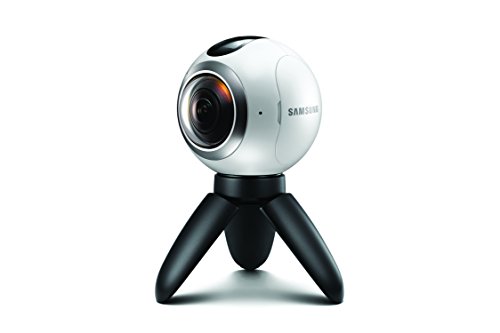
Samsung Gear 360 Real 360° High Resolution VR Camera (US Version with Warranty)
A lightweight, Compact 360-degree Camera
As an affiliate, we earn on qualifying purchases.
As an affiliate, we earn on qualifying purchases.
Conclusion
Think of VR and 360° narratives as a vast, uncharted ocean. Your performance is the skilled sailor’s compass, guiding viewers safely through immersive waters. By adapting your approach, you become the lighthouse that illuminates the journey, ensuring your audience stays engaged and connected. Embrace the challenges as part of the voyage, and remember: in this new domain, your storytelling prowess is the sturdy vessel that transforms exploration into unforgettable adventure.

Rendering the Real: A Developer's Guide to Immersive Worlds in Unity and Unreal Engine (The Platform Architect Series: Code, Hardware, and Mastery)
As an affiliate, we earn on qualifying purchases.
As an affiliate, we earn on qualifying purchases.

KIWI design Audio Head Strap with Battery for Meta/Oculus Quest 3/3S, K4 Duo DualFast Charging Headset, VR Accessories with Balanced Design for Enhanced Sound Effects & Playtime
All-in-One Audio Head Strap with Battery: The K4 Duo Headset revolutionizes your VR experience by combining premium audio…
As an affiliate, we earn on qualifying purchases.
As an affiliate, we earn on qualifying purchases.