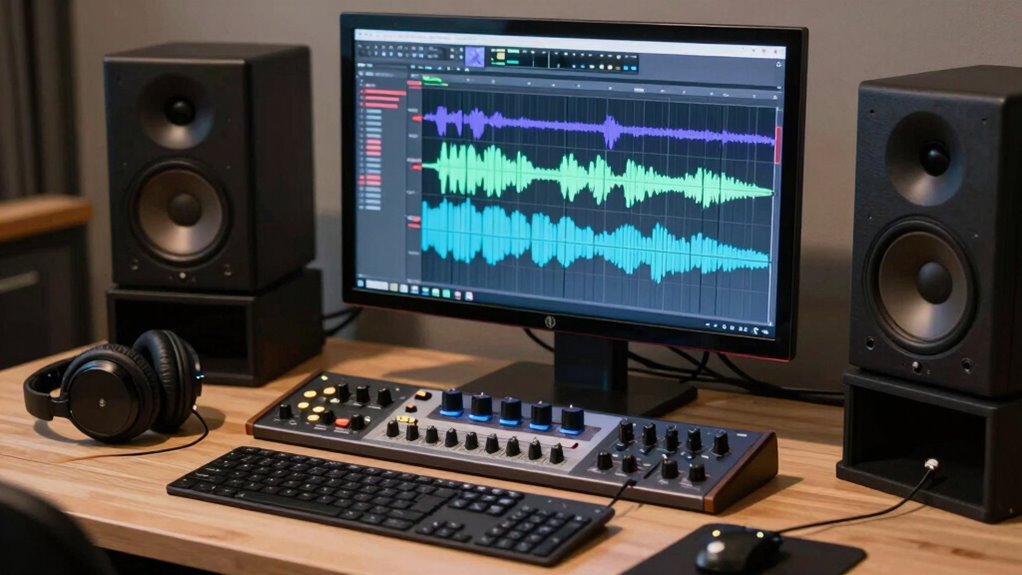
For voice actors, choosing the right powered monitors is vital for accurate, clear playback during recording and editing. The KRK Classic 7 stands out as the best overall choice thanks to its balanced sound and build quality, while the Yamaha HS5 offers a compact, accurate option for smaller spaces. The main tradeoffs involve balancing price, size, and sound accuracy—more expensive models tend to deliver finer detail but can be overkill for casual setups. Keep reading for a detailed breakdown of these models to find the perfect fit for your voice work.

Get everyday helpers delivered free with Prime
- Fast, free delivery on millions of items
- Prime Video, Amazon Music and more included
- Member-only deals all year
Key Takeaways
- Sound accuracy and flat response are critical for voice actors to catch subtle nuances.
- Size and power output vary, with larger monitors offering deeper bass but requiring more space and power.
- Budget options like PreSonus Eris 3.5 provide good value but may lack the detail of higher-end models.
- Build quality and durability matter for long-term reliability in home studios.
- Connectivity options can influence ease of setup depending on your existing gear.
| KRK Classic 7 Powered Studio Monitor |  | Best Overall for Professional Voice Actors | Power: 73 watt | Size: 7 inches | Type: Powered studio monitor | VIEW ON AMAZON | See Our Full Breakdown |
| Electro-Voice PXM-12MP 12-Inch Powered Coaxial Monitor (Pair) |  | Best for Versatile Live Monitoring and Mobile Voice Work | Speaker Size: 12 inches | Type: Powered coaxial monitor | Monitoring Angle: 55 degrees | VIEW ON AMAZON | See Our Full Breakdown |
| Yamaha MS101-4 Desktop Powered Studio Monitor |  | Best Budget-Friendly Desktop Voice Monitoring | Power: 30W | Woofer Size: 4 inches | Tweeter Size: 1 inch | VIEW ON AMAZON | See Our Full Breakdown |
| Yamaha HS5 Powered Studio Monitor |  | Best for Accurate Nearfield Voice Monitoring | Frequency Response: 54Hz-30kHz | Woofer Diameter: 5 inches | Tweeter Diameter: 1 inches | VIEW ON AMAZON | See Our Full Breakdown |
| PreSonus Eris 3.5 Powered Studio Monitors (Pair) |  | Best Compact Monitors for Budget-Oriented Voice Work | Power: 50 watts | Woofer Size: 3.5 inches | Frequency Response: 80 Hz–20 kHz | VIEW ON AMAZON | See Our Full Breakdown |
| KRK Kreate 3 Powered Studio Monitors Pair |  | Best Compact Versatility for Content Creators | Speaker Size: 3.5 inches | Woofer Diameter: 3.5 inches | Color: Black | VIEW ON AMAZON | See Our Full Breakdown |
| Yamaha HS8 8-Inch Powered Studio Monitor Pair – Black |  | Best for Professional Mixing and Critical Voice Recording | Frequency Response: 38Hz – 30kHz | Power Amplification: 120W total (75W LF + 45W HF) | Woofer Size: 8 inches | VIEW ON AMAZON | See Our Full Breakdown |
| Neumann KH 80 DSP 4-Inch Powered Studio Monitor |  | Best for High-Precision Nearfield Monitoring | Speaker Size: 4 inches | Woofer Diameter: 4 inches | Enclosure Material: polycarbonate composite | VIEW ON AMAZON | See Our Full Breakdown |
| Samson MediaOne M30 Powered Studio Monitors (Pair) |  | Best Compact Desktop Choice for Voice Actors | Speaker Size: 3 inches | Woofer Diameter: 3 inches | Tweeter Diameter: 0.75 inches | VIEW ON AMAZON | See Our Full Breakdown |
| Yamaha HS7 7-Inch Powered Studio Monitor Pair |  | Best for Balanced, Professional Voice Monitoring | Frequency Response: 43Hz – 30kHz | Power: 95W total (60W LF + 35W HF) | Inputs: XLR and TRS | VIEW ON AMAZON | See Our Full Breakdown |
| powered monitors for voice actor | Power |
|---|---|
| KRK Classic 7 Powered Studio M | 73 watt |
| Electro-Voice PXM-12MP 12-Inch | — |
| Yamaha MS101-4 Desktop Powered | 30W |
| Yamaha HS5 Powered Studio Moni | — |
| PreSonus Eris 3.5 Powered Stud | 50 watts |
| KRK Kreate 3 Powered Studio Mo | — |
| Yamaha HS8 8-Inch Powered Stud | — |
| Neumann KH 80 DSP 4-Inch Power | — |
| Samson MediaOne M30 Powered St | 20 watts |
| Yamaha HS7 7-Inch Powered Stud | 95W total (60W LF + 35W HF) |
More Details on Our Top Picks
KRK Classic 7 Powered Studio Monitor
The KRK Classic 7 stands out for its high headroom and flexible sound tuning, making it ideal for voice actors who want precise control over their monitoring environment. Compared to the Yamaha HS5, it offers more power and a larger driver, which can better handle dynamic vocal recordings. However, its setup and calibration requirements mean it’s less plug-and-play, demanding a bit of effort to optimize. The adjustable frequency controls give a customizable sound profile, crucial for tailoring your voice to different projects. This monitor excels in larger rooms where clarity and headroom are essential, but smaller setups might find it overkill. Tradeoffs include needing some technical know-how and space for proper placement.
Pros:- High headroom with low distortion
- Flexible placement due to front-firing port
- Customizable sound response with adjustable controls
Cons:- Requires setup and calibration for optimal performance
- Relatively large and heavy, demanding dedicated space
Best for: Professional voice actors or home studio owners seeking accurate, customizable sound with ample power and room for fine-tuning.
Not ideal for: Beginners or those with very limited space, as it requires calibration and a proper setup environment to perform at its best.
- Power:73 watt
- Size:7 inches
- Type:Powered studio monitor
- Amplification:Bi-amped, class A/B
- Enclosure:Heavy-duty
- Ports:Front-firing
Our verdict“This monitor is best suited for voice actors who need detailed sound control and have a suitable space for setup.”
Electro-Voice PXM-12MP 12-Inch Powered Coaxial Monitor (Pair)
The Electro-Voice PXM-12MP offers a portable solution with a 12-inch driver and integrated mixing, making it suitable for voice actors who record in varied environments or perform live. Unlike the Yamaha HS5, which is more suited for stationary studio use, the PXM-12MP’s wireless control and multi-input options provide flexibility for on-the-go setups. Its 55-degree monitoring angle helps focus sound in smaller spaces, but limited power details make it less transparent about its true loudness capabilities. The built-in mixing and wireless app control are convenient for adjusting settings remotely, though reliance on the app means potential compatibility issues. This makes it ideal for voice actors who need mobility and versatile monitoring, but less so for those seeking high-fidelity studio precision.
Pros:- Wireless configuration and monitoring via EV QuickSmart app
- Versatile 3-input mixing section
- Compact, portable design
Cons:- Limited details on power output and durability
- Requires compatible app for full functionality
Best for: Voice actors who record in multiple locations or perform live, needing a portable, all-in-one monitoring solution.
Not ideal for: Studio-only users seeking maximum power and detailed calibration, as the monitor’s portability comes with less emphasis on raw accuracy.
- Speaker Size:12 inches
- Type:Powered coaxial monitor
- Monitoring Angle:55 degrees
- Input Channels:3 (2 XLR/¼” combo, 1 stereo RCA)
- Wireless Control:Yes
Our verdict“Ideal for voice actors who prioritize mobility and flexible setup over absolute studio fidelity.”
Yamaha MS101-4 Desktop Powered Studio Monitor
The Yamaha MS101-4 offers surprisingly powerful sound in a compact form. With 30W of output, it’s well-suited for small home studios or desktop setups where space is limited. Its 4-inch woofer and 1-inch tweeter deliver clear and balanced audio, but compared to larger models like the Yamaha HS5, it may struggle with louder or more dynamic vocal sessions. The 2-band EQ allows basic tone adjustments, yet it doesn’t match the detailed tuning options of higher-end monitors. Its affordability and small footprint make it an attractive choice for voice actors just starting out or working in tight spaces, but it’s less ideal for those needing high volume or deep bass response.
Pros:- Compact size perfect for desktop use
- Powerful 30W output in a small form factor
- Simple 2-band EQ for basic sound adjustments
Cons:- Limited power for larger or more lively rooms
- Basic EQ may not satisfy advanced sound tuning needs
Best for: Beginners or hobbyist voice actors working in small, desktop environments with limited budget and space.
Not ideal for: Professional voice actors recording in larger rooms or requiring detailed sound shaping, as its power and controls are limited.
- Power:30W
- Woofer Size:4 inches
- Tweeter Size:1 inch
- EQ:2-band
Our verdict“This monitor is a practical choice for beginners or small-space voice actors seeking affordability and simplicity.”
Yamaha HS5 Powered Studio Monitor
The Yamaha HS5 excels at delivering clear, flat frequency response, making it a favorite for voice actors who need precise monitoring for editing and mixing. Its 5-inch woofer and 1-inch dome tweeter produce a balanced sound across a broad frequency range, comparable to the KRK Classic 7 but with less power—45W LF and 25W HF. For voice work, this means accurate representation without exaggerated bass or treble. The HS5’s durability and versatile input options (XLR and TRS) suit professional environments, but it’s primarily designed for nearfield use, so large rooms may require additional speakers. It lacks the power headroom of larger monitors, which limits its use in more dynamic or loud environments.
Pros:- High-quality, flat frequency response for accurate monitoring
- Versatile XLR and TRS inputs
- Room control and high trim features for tailored sound
Cons:- Limited to nearfield use, not suitable for large spaces
- Less powerful than larger monitors, may struggle in lively rooms
Best for: Voice actors and editors needing precise, uncolored sound for detailed review and editing in small to medium spaces.
Not ideal for: Larger studios or voice actors who require high volume and bass depth, as the HS5 is optimized for nearfield critical listening without added bass boost.
- Frequency Response:54Hz-30kHz
- Woofer Diameter:5 inches
- Tweeter Diameter:1 inches
- Power Output:70W total
- Additional Features:Bass Boost, Room Control, High TRIM
Our verdict“This monitor is ideal for precise voice editing and mixing in small, controlled environments.”
PreSonus Eris 3.5 Powered Studio Monitors (Pair)
The PreSonus Eris 3.5 provides studio-quality sound in a very small footprint, making it perfect for tight spaces or secondary monitoring. Its 50W power ensures clear playback for voice recordings, but the 3.5-inch woofer limits bass response, which can be noticeable when evaluating vocal depth or fullness. Compared to the Yamaha MS101-4, it offers more input flexibility and built-in tone controls, allowing for better sound tailoring. However, the small size means it’s less suited for environments where loudness and bass are priorities. This pick makes the most sense for voice actors who need accurate sound in a limited space without the need for deep bass or high volume.
Pros:- Delivers clear, distortion-free sound
- Compact size fits on any desk
- Multiple input options and tone controls
Cons:- Limited bass response due to small woofer
- No wireless connectivity options
Best for: Content creators or voice actors working in compact spaces who need accurate monitoring at an affordable price.
Not ideal for: Professionals working in large rooms or those needing powerful bass response, as the small woofer cannot deliver deep low frequencies.
- Power:50 watts
- Woofer Size:3.5 inches
- Frequency Response:80 Hz–20 kHz
- Inputs:TRS, RCA, aux
- Features:Tone controls, headphone output
Our verdict“This monitor is well-suited for voice actors in small setups seeking accurate, budget-friendly sound monitoring.”
KRK Kreate 3 Powered Studio Monitors Pair
The KRK Kreate 3 monitors stand out for their combination of portability and connectivity, featuring Bluetooth input and multiple audio options that suit voice actors who work across different devices. Compared with larger monitors like the Yamaha HS8, they sacrifice some low-end depth but gain in convenience and space efficiency. This makes them ideal for voice actors recording in small spaces or on the go, though their small 3.5-inch size may limit bass response and overall volume for more demanding applications. The lightweight design and Bluetooth support provide flexibility, but the absence of detailed amplification specs could concern those seeking precise power ratings. Best for voice actors needing a versatile, space-saving monitor with wireless options.Pros:- Clear and accurate sound reproduction
- Wireless Bluetooth connectivity
- Multiple input options for versatile use
- Compact and lightweight design
Cons:- Limited to 3.5-inch size may not suit all professional needs
- No mention of built-in amplification details
Best for: Voice actors working in small studios or portable setups needing wireless and multiple input options.
Not ideal for: Professionals requiring deep bass and high-volume output, as the small 3.5-inch size limits low-frequency performance.
- Speaker Size:3.5 inches
- Woofer Diameter:3.5 inches
- Color:Black
- Speaker Type:Monitor
- Audio Output Mode:Stereo
- Mounting Type:Tabletop
- Power Source:Corded Electric
- Compatibility:Desktop, Gaming Console, Home Theater, Laptop, MP3 Player, Projector, Smartphone, Tablet, Television
Our verdict“This monitor makes the most sense for voice actors seeking a compact, versatile option with wireless connectivity for casual or mobile studio use.”
Yamaha HS8 8-Inch Powered Studio Monitor Pair – Black
The Yamaha HS8 monitors deliver exceptional accuracy with an 8-inch woofer and a powerful 120W bi-amp system, making them ideal for voice actors who need precise sound for editing and post-production. Unlike the smaller KRK Kreate 3, they provide a broader frequency response and more substantial bass, which benefits voice clarity and overall fidelity. These are better suited to professional environments where detailed audio reproduction is critical, but their size and expense can be off-putting for casual users or those in tight spaces. Proper placement is necessary to avoid bass muddiness, but their robustness ensures durability in a studio setup. Best for voice actors serious about high-fidelity monitoring in dedicated studio environments.Pros:- Highly accurate sound reproduction for professional mixing
- Bi-amp design reduces phase issues
- Robust construction with vibration-eliminating mounts
- Wide frequency response for detailed audio
Cons:- May be expensive for casual users
- Requires careful placement for optimal performance
Best for: Voice actors engaged in professional editing or mastering who require accurate, full-range sound reproduction.
Not ideal for: Casual voice actors or hobbyists with limited space or budget, as these monitors are costly and sizable.
- Frequency Response:38Hz – 30kHz
- Power Amplification:120W total (75W LF + 45W HF)
- Woofer Size:8 inches
- Tweeter Size:1 inch
- Bi-amp System:Yes
- Magnet Type:Large magnets with advanced magnetic circuit
Our verdict“These monitors suit voice actors needing precise, professional-grade sound in a dedicated studio environment.”
Neumann KH 80 DSP 4-Inch Powered Studio Monitor
The Neumann KH 80 DSP offers advanced DSP-controlled bi-amplification in a compact 4-inch package, making it ideal for nearfield monitoring where space is limited. Compared with larger models like the Yamaha HS7, the KH 80 emphasizes high-fidelity sound with network control, perfect for voice actors who want detailed sound without cluttering their workspace. Its DSP engine allows for precise tuning, but the higher price and requirement for network setup could be barriers for those seeking simple plug-and-play solutions. Its durable polycarbonate enclosure and high-quality dispersion make it suitable for professional environments, though it may be overkill for casual or mobile setups. Best for voice actors who want high-end, network-enabled nearfield monitoring with precise dispersion control.Pros:- High-quality DSP-controlled sound
- Network connectivity for remote tuning
- Compact, durable design
- Precise dispersion for accurate imaging
Cons:- Premium price point
- Requires network setup for full feature access
- Limited to 4-inch size, not suitable for large rooms
Best for: Voice actors working in professional or semi-professional studios needing detailed control and high-fidelity sound.
Not ideal for: Beginners or users with limited technical setup experience, due to the network configuration and calibration required.
- Speaker Size:4 inches
- Woofer Diameter:4 inches
- Enclosure Material:polycarbonate composite
- Control Method:App
- Additional Features:DSP Engine, MMD Waveguide
- Warranty:2 years
Our verdict“This monitor is ideal for dedicated studio environments where high-fidelity, customizable sound is a priority for voice editing.”
Samson MediaOne M30 Powered Studio Monitors (Pair)
The Samson MediaOne M30 monitors excel as a compact, full-range solution for voice actors working at their desks, with a 3-inch polypropylene woofer and silk-dome tweeter delivering clear, balanced sound. Compared to larger monitors like the Yamaha HS7, their smaller size limits low-end punch but makes them ideal for tight spaces and desktop use. The internal 20-watt amplifier provides enough power for casual recording and editing, but not for loud environments or large rooms. Their sleek black design fits seamlessly into a home studio, though their limited power output might fall short for more demanding post-production. Best for voice actors seeking a small, full-range monitor for desktop or multimedia work without the need for high volume.Pros:- Compact and sleek design for desktop use
- Full-range sound with clear highs and tight lows
- Powered by internal amplifier for simplicity
- Suitable for multimedia and casual voice work
Cons:- Limited to indoor use
- Small size may limit bass and volume
- Power output may be insufficient for loud environments
Best for: Voice actors in home or small studio setups needing a compact, all-in-one monitor for casual editing and recording.
Not ideal for: Professional studios or loud environments requiring higher output and bass response.
- Speaker Size:3 inches
- Woofer Diameter:3 inches
- Tweeter Diameter:0.75 inches
- Power:20 watts
- Enclosure Material:Polypropylene
- Color:Black
- Mounting Type:Tabletop
Our verdict“This monitor is perfect for voice actors working in small spaces who need reliable, full-range sound at moderate volumes.”
Yamaha HS7 7-Inch Powered Studio Monitor Pair
The Yamaha HS7 monitors provide a versatile, high-quality audio experience with a 7-inch woofer and a 95W bi-amp system, making them suitable for voice actors who require accurate monitoring for editing and mixing. While the HS7 offers broader low-frequency response than smaller models like the M30, it’s also larger and more expensive, making it less ideal for very tight spaces. Their wide frequency response (43Hz – 30kHz) and balanced input options make them a favorite among professionals, though the size and price might deter casual users. Proper placement is key to avoiding bass muddiness, but their durability and sound quality justify the investment. Best for voice actors who need detailed, balanced sound for critical editing in a professional studio environment.Pros:- High-quality, wide frequency response
- Versatile input options for professional setups
- Powerful bi-amp system for clarity
- Durable build quality
Cons:- Higher cost for entry-level users
- Requires space for proper placement
Best for: Professional voice actors engaged in editing, mastering, or post-production requiring accurate, full-range monitoring.
Not ideal for: Beginners or casual voice actors working in small, cluttered spaces or with limited budgets.
- Frequency Response:43Hz – 30kHz
- Power:95W total (60W LF + 35W HF)
- Inputs:XLR and TRS
Our verdict“This monitor set is ideal for voice actors needing precise, professional-grade sound for detailed editing and production work.”

How We Picked
This lineup was curated by evaluating each monitor’s sound fidelity, build quality, and usability specifically for voice work. We prioritized flat frequency response for accurate playback, as well as size and power options suitable for home studios. Maintenance and durability were considered, along with value for the price. Products were ranked based on how well they balance these factors, with a focus on clarity, reliability, and overall performance for voice actors working in various environments.Factors to Consider When Choosing Powered Monitors For Voice Actors
When selecting powered monitors for voice acting, it’s essential to consider several factors beyond basic features. The right monitor should deliver accurate sound without coloration, so you can truly hear your voice as it will be heard by listeners or clients. Compatibility with your existing gear, room size, and budget are also key. Making the wrong choice can lead to misjudging your voice tone or missing subtle audio cues, which impacts the quality of your recordings. Here are the most important factors to keep in mind:Sound Accuracy and Frequency Response
For voice actors, flat and neutral sound reproduction is paramount. Monitors with exaggerated bass or treble can mislead your perception of your voice’s true tone. Look for models that emphasize a balanced frequency response, ensuring you hear your voice as accurately as possible. This accuracy helps in identifying pitch issues, pronunciation, and tone variations that are critical for professional recordings.
Size, Power, and Space Considerations
The physical size of your monitors influences both sound and studio layout. Larger monitors generally produce deeper bass and louder volumes but require more space and power. Smaller models may be more suitable for compact setups but can lack low-end depth. Consider your room dimensions and whether you need volume for noisy environments or quiet, detailed work.
Connectivity and Compatibility
Ensure your monitors can connect seamlessly with your audio interface or mixer. Common connections include XLR, TRS, and RCA. Some models also offer Bluetooth or auxiliary inputs, providing flexibility. Compatibility issues can cause frustration or degraded sound quality, so check that your gear supports the monitor’s connection options before purchasing.
Build Quality and Durability
Monitors used regularly in a home studio should be robust enough to withstand daily use. Look for solid construction, quality drivers, and reputable brands. Well-built monitors tend to maintain calibration over time, delivering consistent sound. Cheaper models may save money upfront but can suffer from internal component failure or sound drift.
Budget and Value
Setting a realistic budget helps narrow your options. While high-end monitors offer superior detail and durability, they come with a higher price tag. Budget-friendly options can still perform well for casual or beginner voice actors but may lack certain refinements. Balance your needs with what you’re willing to invest—sometimes spending more upfront saves money on upgrades later.
Frequently Asked Questions
Are powered monitors better than passive monitors for voice acting?
Powered monitors integrate their own amplifiers, simplifying setup and reducing cable clutter, which is advantageous for home studios. Their built-in amplification is optimized for the speakers, often providing a cleaner, more consistent sound. Passive monitors require an external amp, which adds complexity and potential points of failure. For voice actors prioritizing simplicity and reliability, powered monitors are generally the better choice.
How important is room size when choosing monitors for voice work?
Room size significantly influences monitor selection because larger rooms benefit from bigger, more powerful speakers that fill the space without distortion. Smaller studios require monitors that don’t overwhelm the space or cause acoustic issues. Proper placement and acoustic treatment also play vital roles. Matching monitor size to your room helps prevent sound muddiness or excessive reflection, ensuring clearer voice playback.
Can I use regular music studio monitors for voice acting?
Yes, many studio monitors are versatile enough for voice work, provided they have a flat, accurate response. However, not all monitors are optimized for spoken audio, as some emphasize bass or treble. For voice acting, prioritize models known for neutrality and clarity. This ensures you hear your voice without coloration, which is essential for editing and performance evaluation.
Is it worth investing in high-end monitors if I’m just starting out?
Investing in high-end monitors can be beneficial if you aim for professional-quality recordings and want precise audio feedback. However, for beginners or hobbyists, mid-range models often suffice and provide excellent value. Higher-end options may offer finer details and durability but come at a steep cost. Assess your current needs and future goals before committing to premium equipment.
How do I know if a monitor’s frequency response is suitable for voice acting?
Frequency response charts typically show the range the monitor can reproduce, but for voice actors, the key is a flat response within the vocal range, around 80Hz to 12kHz. Look for monitors praised for neutrality rather than exaggerated bass or treble. Listening to reviews or testing in your space can help confirm whether the monitor faithfully reproduces voices without coloring them.
Conclusion
For those starting out or working in small home studios, the Yamaha HS5 offers a compact, accurate sound at a reasonable price, making it ideal for beginners. Voice actors seeking the best overall experience should consider the KRK Classic 7 for its balanced sound and durability. Professionals or dedicated voice artists aiming for maximum fidelity may find the Neumann KH 80 DSP to be a worthwhile investment despite its higher cost. Budget-conscious buyers will appreciate the value offered by models like the PreSonus Eris 3.5, which still delivers decent clarity for voice work. Ultimately, your choice depends on your space, budget, and need for precision—use this guide to find the perfect match.
Fall Picks
fall essentials
As an affiliate, we earn on qualifying purchases.