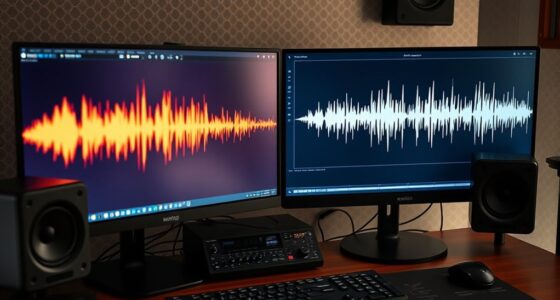
To measure the noise floor accurately, you need precise tools like spectrum analyzers and low-noise preamplifiers, ensuring proper calibration with known references before testing. Control your audio bandwidth with filters, and always check environmental factors such as temperature and interference that can affect your results. Recalibrate regularly for consistent accuracy. Following these best practices will help you capture true background noise levels, and if you keep exploring, you’ll discover how to optimize your system performance effectively.
Key Takeaways
- Use high-quality spectrum analyzers and low-noise preamplifiers for precise measurements.
- Calibrate measurement tools regularly with calibrated noise sources to ensure accuracy.
- Limit audio bandwidth during testing to focus on relevant frequency ranges and avoid obscuring data.
- Control environmental factors like temperature and electromagnetic interference to reduce measurement variability.
- Record multiple readings and document conditions for consistent, reliable noise floor assessments.

Measuring the noise floor is vital for understanding the background level of unwanted signals in your audio or electronic systems. This process helps you identify the inherent noise that exists even when no input signal is present, providing a baseline for optimizing performance. When performing this measurement, it’s important to consider your system’s audio bandwidth because the noise floor can vary markedly across different frequency ranges. Limiting your measurement to a specific bandwidth ensures you get an accurate representation of the noise relevant to your application, whether it’s high-fidelity audio, RF communication, or other electronic systems. A broader bandwidth captures more noise, but it can also obscure the true background level within the frequency range of interest. Narrowing the bandwidth helps you focus on the noise relevant to your system’s operational spectrum, giving you a clearer picture of your environment’s actual background noise. Additionally, understanding the automation in business landscape can aid in selecting appropriate measurement tools and methodologies for different industrial applications. Calibration plays a pivotal role in obtaining reliable and consistent results. Before taking any measurements, you need to calibrate your equipment properly. This involves using a known reference signal or a calibrated noise source to set a baseline for your measurement device. Calibration ensures that your readings are accurate and comparable over time, reducing errors that might arise from device drift or environmental factors. Proper calibration also helps in establishing a consistent measurement procedure, which is especially important when comparing results across different systems or testing sessions. Remember, an uncalibrated or poorly calibrated measurement setup can lead to misleading data, making it harder to diagnose issues or improve your system’s performance. To effectively measure the noise floor, you should use high-quality measurement instruments, such as a spectrum analyzer or a low-noise preamplifier, that allow you to set and control your audio bandwidth precisely. When setting up your measurement, start by ensuring your equipment is warmed up and stabilized, then perform calibration to guarantee accuracy. Use filters to define your bandwidth, making sure you’re only capturing the noise within your specified range. Record your readings multiple times to account for variability, and take note of environmental factors like temperature and electromagnetic interference, which can influence the noise level. Regularly review and recalibrate your measurement tools to maintain precision over time. By following these best practices, you’ll obtain a clear, reliable picture of your system’s noise floor, enabling you to make informed decisions for improvement and optimization.
Top picks for "noise floor measurement"
Open Amazon search results for this keyword.
As an affiliate, we earn on qualifying purchases.
Frequently Asked Questions
How Does Ambient Temperature Affect Noise Floor Readings?
Ambient temperature can impact your noise floor readings by affecting measurement accuracy. When the temperature is too high or low, it can cause equipment components to drift, leading to inaccurate results. You should monitor ambient temperature closely and calibrate your equipment accordingly to make certain of precise measurements. Maintaining a stable environment helps reduce temperature-related variations, ensuring your noise floor readings remain consistent and reliable regardless of ambient temperature fluctuations.
What Are Common Mistakes When Calibrating Measurement Tools?
Did you know that calibration errors account for up to 30% of measurement inaccuracies? When calibrating your tools, you often make mistakes like neglecting equipment misalignment or skipping regular calibration checks. These errors can lead to unreliable readings, compromising your data quality. Always make certain your equipment is properly aligned and calibrated regularly. Avoid rushing the process, and double-check your standards to maintain accurate noise floor measurements.
How Often Should Noise Floor Measurements Be Repeated?
You should repeat noise floor measurements regularly, ideally following your calibration schedule, to guarantee ongoing accuracy. The measurement frequency depends on your environment and equipment stability but generally ranges from weekly to quarterly. By maintaining a consistent calibration schedule, you can detect any drift or changes early, ensuring your noise measurements remain reliable. Always adjust your measurement frequency based on equipment performance and environmental conditions to keep your data trustworthy.
Can Noise Floor Vary Significantly During Different Times of Day?
Think of the noise floor as a chameleon, changing colors with the time of day. Yes, it can vary markedly, influenced by environmental factors like traffic, weather, and human activity. During busy daytime hours, noise levels rise like a bustling city, while at night, they drop to a whisper. So, you must consider these fluctuations when measuring noise floors to guarantee accurate, reliable results.
What Advanced Tools Are Available for Ultra-Low Noise Measurements?
You can use quantum sensors and cryogenic amplifiers for ultra-low noise measurements. Quantum sensors leverage quantum properties to detect extremely faint signals, achieving unparalleled sensitivity. Cryogenic amplifiers operate at very low temperatures, reducing thermal noise and enhancing measurement precision. Combining these advanced tools allows you to accurately measure ultra-low noise floors, making them ideal for applications demanding the highest sensitivity, such as fundamental physics experiments or cutting-edge research.
Conclusion
Measuring the noise floor is like tuning into a whisper in a crowded room—you need the right tools and techniques to hear it clearly. By understanding and applying best practices, you can distinguish genuine signals from background noise with confidence. Think of it as fine-tuning your ears to pick up even the faintest sounds. Mastering these methods guarantees your measurements are accurate, giving you a clearer picture of your environment’s true noise landscape.