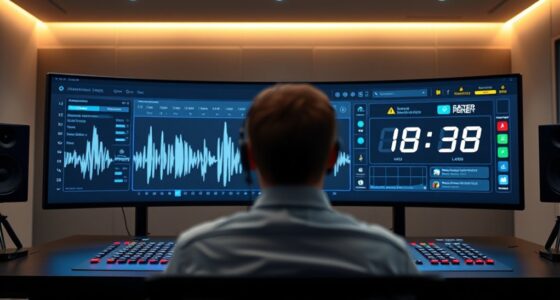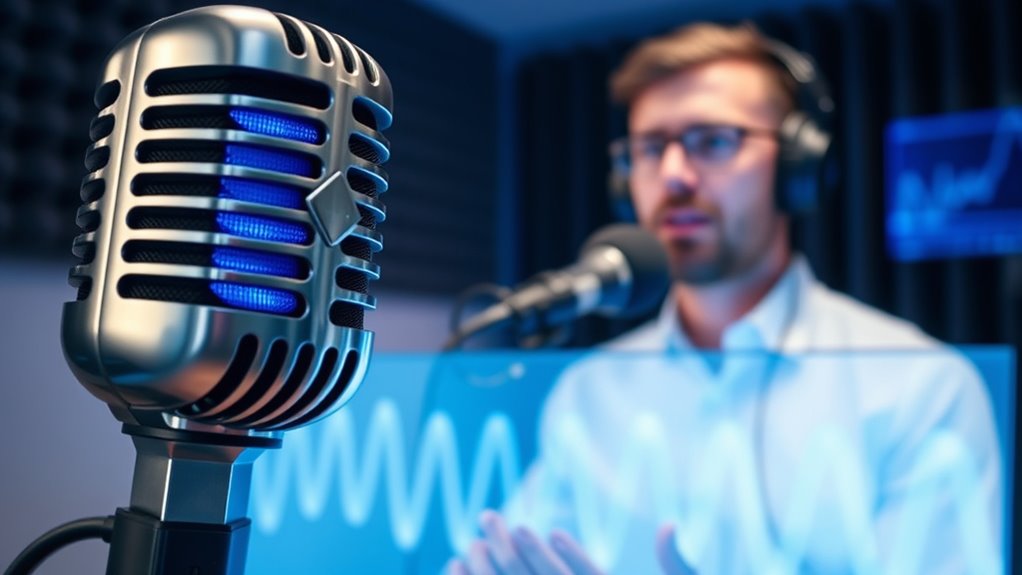

Voice biometrics offers voice actors a secure way to authenticate their identities by using their unique voice features. This technology captures aspects like pitch, tone, and rhythm to create a digital voice print that’s hard to replicate. It allows quick, hands-free access and reduces reliance on passwords, keeping your identity protected. If you want to discover more about how this innovative authentication method can benefit voice actors, you’ll find valuable insights ahead.
Key Takeaways
- Voice biometrics can authenticate voice actors securely by verifying their unique voice prints during recordings or performances.
- It ensures the authenticity of voice recordings, preventing impersonation or unauthorized use of voice assets.
- Voice actors’ biometric profiles help protect their intellectual property from theft or digital forgery.
- Implementing voice biometrics streamlines access to voice talent databases and project files securely.
- Continuous voice print updates improve accuracy for voice actors across different emotional and environmental conditions.

Have you ever wondered how your voice can serve as a secure way to verify your identity? Voice biometrics uses unique features of your voice to establish a digital fingerprint called a voice print. This voice print captures the distinctive characteristics of your speech, such as pitch, tone, cadence, and rhythm. When you speak into a device, advanced algorithms analyze these features to create a profile that’s uniquely yours. This process is central to speaker verification, a technology that confirms whether the voice speaking matches the stored voice print. Unlike passwords or PINs, your voice is a biometric that’s difficult to forge or steal, making it an attractive option for secure authentication.
Voice prints uniquely identify individuals, making voice biometrics a secure and convenient authentication method.
The core idea behind voice biometrics is that every person has a unique voice print. When you enroll in a voice verification system, your voice is recorded and processed to generate this distinctive profile. Later, when you need to access a secure system, you simply speak a phrase, and the system compares the current voice sample to your stored voice print. If the features align closely, access is granted. This process happens quickly, often within seconds, providing a seamless yet highly secure experience. Because voice prints are derived from physical and behavioral traits, they’re difficult to mimic precisely, adding an extra layer of security.
Speaker verification via voice biometrics is especially useful in scenarios where traditional methods like passwords fall short. For instance, in customer service centers or banking, voice authentication enables quick, hands-free access without compromising security. It also minimizes the risk of fraud since a criminal would need to replicate your voice characteristics perfectly—a nearly impossible feat. Moreover, voice biometrics doesn’t require users to remember complex codes or carry physical tokens, making it convenient and user-friendly.
However, it’s important to recognize that voice biometrics isn’t infallible. Background noise, illness, or emotional states can temporarily alter your voice, potentially impacting the accuracy of speaker verification. That’s why many systems incorporate multi-factor authentication or continuously update voice prints to adapt to subtle changes over time. Despite these challenges, advancements in speech analysis and machine learning are continuously improving the reliability of voice biometrics. Additionally, understanding the principles of ethical hacking can help in developing secure voice authentication systems that are resistant to spoofing and other attacks.]
Open Amazon search results for this keyword. As an affiliate, we earn on qualifying purchases.Top picks for "voice biometric secure"
Frequently Asked Questions
Can Voice Biometrics Detect Deepfake Voice Impersonations?
Yes, voice biometrics can help detect deepfake voice impersonations by identifying subtle inconsistencies and unique vocal features. It enhances deepfake detection and reduces impersonation risks, ensuring secure authentication. Your system can analyze voice patterns more precisely than traditional methods, making it harder for malicious actors to spoof voices convincingly. By continuously improving algorithms, you can stay ahead of deepfake technology and safeguard your voice-based security measures effectively.
How Does Background Noise Affect Voice Biometric Accuracy?
Imagine speaking confidently, but suddenly background noise flares up. Noise interference can seriously disrupt your voice biometric accuracy, making it harder for systems to verify you. The quality of your microphone matters too; a poor one captures more noise, leading to false rejections. To stay secure, guarantee a quiet environment and use high-quality microphones. Otherwise, background chaos might just mask your true voice, risking authentication failure.
Is Voice Biometrics Suitable for Multi-Language Authentication?
Yes, voice biometrics can handle multi-language authentication, but you should be aware of multilingual challenges and accent variability. These factors can affect accuracy, so it’s crucial to use advanced algorithms trained on diverse language samples. By doing so, you improve recognition across different languages and accents, ensuring secure and reliable authentication. Proper system design and regular updates help overcome these challenges, making voice biometrics a viable option for multilingual users.
What Are the Privacy Concerns Associated With Voice Data Storage?
Did you know that over 80% of consumers worry about their voice data privacy? You should be concerned too, because storing voice data raises privacy issues like unauthorized access or misuse. To protect yourself, organizations use data encryption and enforce strict access restrictions. These measures help guarantee your voice data remains secure, preventing potential identity theft or privacy breaches, and giving you peace of mind when using voice authentication systems.
How Quickly Can Voice Biometrics Authenticate a User?
You can expect voice biometrics to authenticate you in just a few seconds, often under a second, provided your voice sample quality is high. The process is quick because the system uses advanced algorithms that analyze your unique voice features rapidly. Enrollment speed matters too; the better your initial voice sample, the faster the system can verify your identity in future authentications, ensuring a seamless and efficient experience.
Conclusion
As you embrace voice biometrics, think of your voice as a unique key—each tone and inflection revealing a world of secure access. Just like a lighthouse guiding ships safely home, your voice becomes a symbol of trust and identity in a sea of digital threats. With this technology, you hold the power to protect your voice’s integrity, ensuring your authentic self shines through, steadfast and secure in a future where your voice truly is your most personal password.