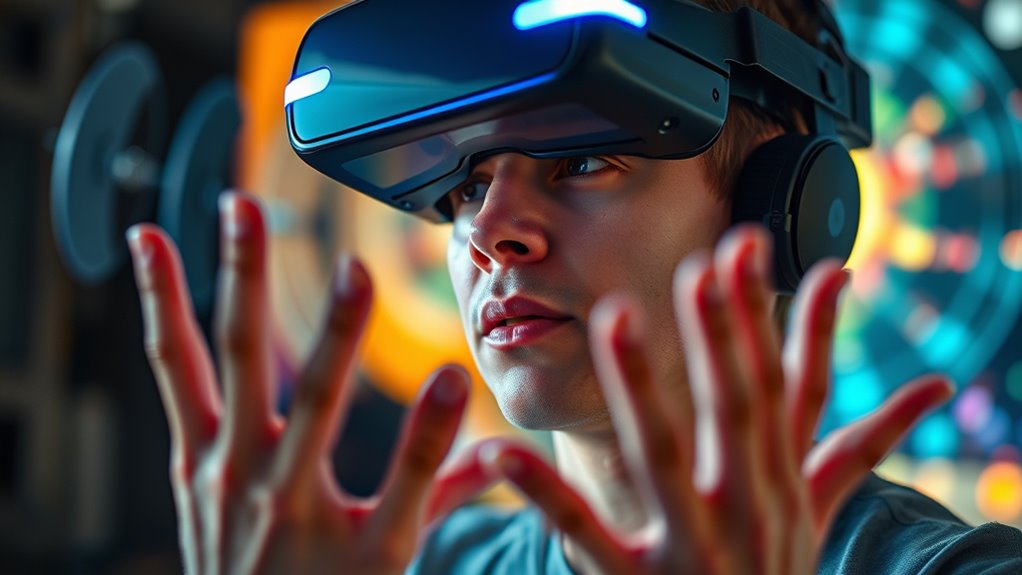

Using VR tools can markedly boost your voice acting by immersing you in realistic environments that deepen emotional connection and enhance spatial awareness. These tools let you rehearse scenes repeatedly, experiment with different tones, and receive real-time feedback on your performance and positioning. VR makes your practice more flexible, engaging, and precise, helping you deliver more authentic performances. Stay tuned to learn how these innovations can transform your voice acting skills even further.
Key Takeaways
- VR tools create immersive environments that deepen emotional engagement and authenticity in voice acting performances.
- They help develop spatial awareness, improving timing, positioning, and environmental influence on vocal delivery.
- VR enables flexible rehearsal options, allowing repeated practice and experimentation with emotional tones and scene setups.
- Integrated feedback systems analyze emotional expression and spatial cues to refine performance precision.
- Advanced VR technology enhances realism and emotional depth, translating virtual training into more authentic real-world voice work.
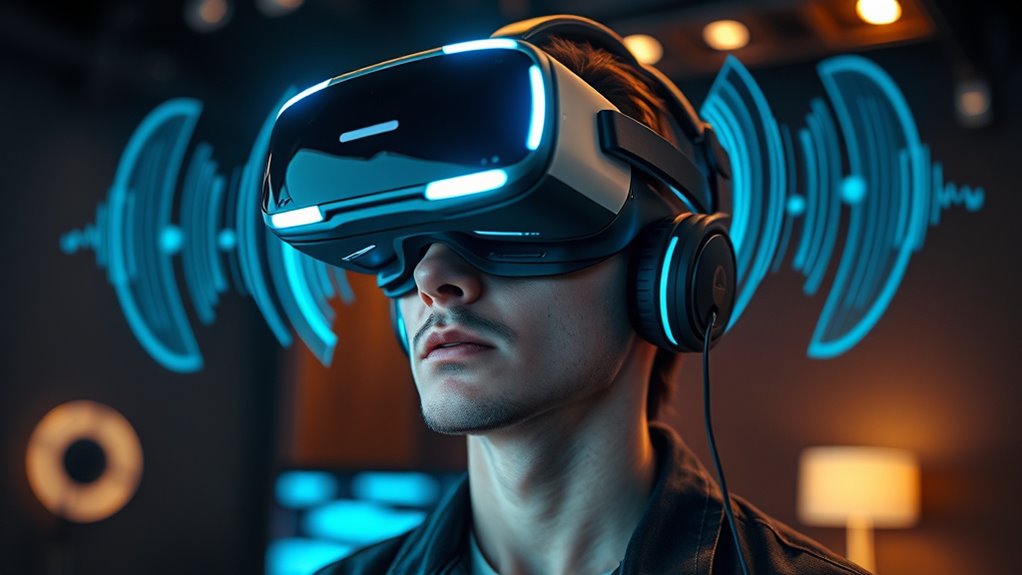
Virtual reality tools are transforming how voice actors hone their craft by providing immersive, interactive environments that mimic real-world scenarios. These tools allow you to step into diverse settings, from bustling city streets to quiet, intimate rooms, helping you develop a deeper sense of emotional immersion. When you’re fully immersed in a VR environment, you can better connect with the emotions your character needs to express, making your performance more genuine and compelling. The realism of these environments encourages you to tap into authentic feelings, as if you’re truly experiencing the scene firsthand. This heightened emotional engagement ensures your voice conveys the appropriate depth and nuance, elevating your overall acting quality.
Beyond emotional immersion, VR tools considerably enhance your spatial awareness. As you navigate virtual spaces, you become more conscious of your positioning relative to other characters, objects, and environmental cues. This spatial awareness is essential for delivering performances that feel natural and well-timed, especially in scenes that involve interaction or movement. For instance, if your character is in a crowded marketplace or a quiet library, VR can simulate the spatial dynamics, helping you understand how proximity and environment influence your vocal delivery. Increased spatial awareness also aids in timing your cues accurately, ensuring your voice aligns seamlessly with the scene’s physical context.
Using VR, you can rehearse scenes repeatedly, experimenting with different emotional tones and spatial arrangements without the need for physical location changes. This flexibility accelerates your learning process, allowing you to refine your emotional responses and spatial cues until they feel instinctive. When you practice in a VR setting, you gain confidence in your ability to adapt quickly to new scenarios, which is essential for dynamic voice acting roles. Moreover, the interactive nature of VR encourages active engagement, making each rehearsal more effective and less passive than traditional methods.
In addition, VR tools often incorporate feedback systems that analyze your emotional expression and spatial positioning, offering insights to improve your performance. With real-time data on how well you’re conveying emotions or maintaining spatial awareness, you can make targeted adjustments, ensuring your voice work is precise and impactful. This technology also benefits from advancements in projector technology, which enhance the realism and clarity of virtual environments. Over time, this immersive practice translates into more authentic performances in real-world settings, where emotional depth and spatial sensitivity are indispensable. By integrating VR into your training routine, you harness cutting-edge technology to sharpen your skills, making your voice acting more expressive, immersive, and versatile.
Top picks for "tool enhance voice"
Open Amazon search results for this keyword.
As an affiliate, we earn on qualifying purchases.
Frequently Asked Questions
How Does VR Improve Emotional Expression in Voice Acting?
VR improves emotional expression in voice acting by immersing you in realistic environments, helping you connect deeply with characters and scenes. This immersion boosts your emotional depth, making your performance more authentic. VR also allows you to practice expressive techniques in varied scenarios, enhancing your ability to convey emotions convincingly. As a result, you deliver more nuanced, compelling voice performances that resonate with your audience.
Can VR Tools Simulate Different Voice Acting Environments Realistically?
VR tools can simulate different voice acting environments with remarkable realism, like stepping into a new world. You experience virtual environmental simulations that mimic real spaces, enhanced by realistic acoustic modeling. This makes you feel like you’re recording in a concert hall or bustling street, helping you adapt your voice naturally. Such immersive environments sharpen your skills, making your performances more authentic and emotionally compelling, as if you’re truly part of the scene.
What Are the Costs Associated With Implementing VR for Voice Training?
The costs of implementing VR for voice training include hardware costs for VR headsets and controllers, which can range from a few hundred to over a thousand dollars. You’ll also need software licensing fees for specialized VR training programs, which vary depending on the provider. Additionally, consider expenses like powerful computers to run the VR setup smoothly and ongoing maintenance costs. Budgeting for these elements helps guarantee a successful investment in your voice training.
How Do VR Tools Cater to Different Voice Acting Genres?
You might think VR tools are limited to certain genres, but their genre adaptability and tool versatility actually make them invaluable across all voice acting styles. You can simulate intense emotional scenes for drama, lively characters for animation, or even realistic environments for narration. This flexibility guarantees you can tailor your training to specific genres, helping you refine your performance in a way that traditional methods simply can’t match.
Are There Any Privacy Concerns With Using VR in Voice Recording?
Yes, there are privacy concerns when using VR in voice recording. You need to be aware of data security risks, as your recordings and personal information could be vulnerable if the platform doesn’t have proper protections. Always check the VR tool’s privacy policies to guarantee your user privacy is protected, and consider using secure networks to minimize exposure. Staying informed helps you safeguard your work and personal data effectively.
Conclusion
Embracing VR tools is like opening a window to a whole new world of voice acting possibilities. With each virtual scene, you can breathe life into characters more vividly than ever before. This technology isn’t just a tool; it’s a bridge that connects your voice to immersive experiences, transforming your performance from a mere echo into a powerful symphony. Plunge in, explore, and let your talent soar beyond the limits—your best voice acting journey awaits.