
Get everyday helpers delivered free with Prime
- Fast, free delivery on millions of items
- Prime Video, Amazon Music and more included
- Member-only deals all year
The Real Decision Behind Hearing Amplification
When hearing starts to slip, most people arrive at the same fork in the road: buy a cheap amplification device online, or go to an audiologist and pay thousands for prescription hearing aids. On one side sit Personal Sound Amplification Products (PSAPs) and over-the-counter amplifiers — devices priced from roughly $50 to $800 that you buy, charge, and wear without anyone examining your hearing. On the other side sit prescription hearing aids, typically $2,000 to $7,000 per pair, which are fitted after a professional hearing test and programmed to your specific audiogram.

Rechargeable Hearing Amplifier with Directional Noise-Canceling Microphone for Seniors
- ✔ Maximum Sound Gain: 65dB
- ✔ Battery Type: Rechargeable (built-in)
- ✔ Charging Time: 1 hour
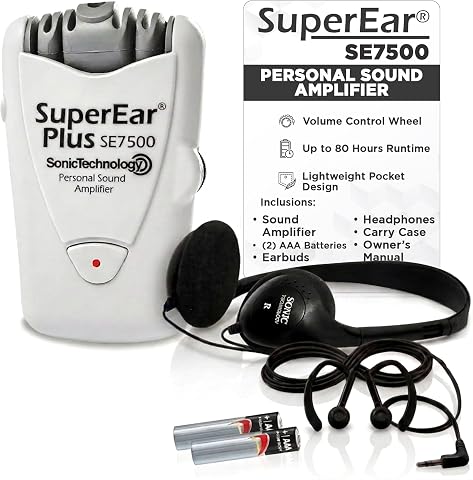
SuperEar Plus SE7500 Personal Sound Amplifier for Seniors
- ✔ Model: SE7500
- ✔ Sound Gain: Up to 50+ dB
- ✔ Battery Life: Up to 80 hours
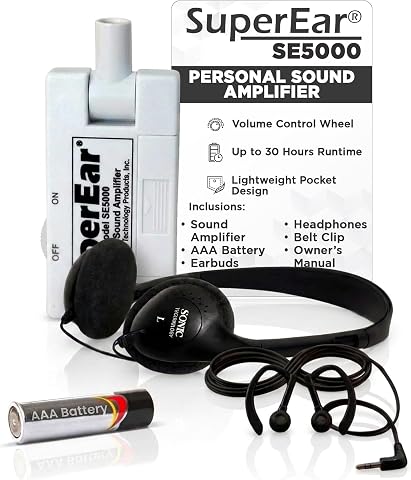
SuperEar SE5000 Personal Sound Amplifier for Seniors with Headphones and Earbuds
- ✔ Amplification: Up to 50+ dB
- ✔ Battery: 1x AAA (included)
- ✔ Battery Life: Up to 30 hours
The comparison is really about three intertwined questions. First, how bad is your hearing — situational difficulty or a diagnosed loss? Second, how much processing quality matters to you, because the gap between a $200 amplifier and a $4,000 hearing aid is not just volume, it is how sound is shaped, cleaned, and delivered. Third, how much hand-holding you want, from fitting to follow-up adjustments.
This guide compares the two side by side across the criteria that actually drive the decision: sound processing, cost, fitting and customization, suitability by hearing loss severity, features, professional support, and regulation. The short version: if you have mild difficulty hearing in restaurants or on TV, a quality PSAP or OTC device can genuinely help at a fraction of the price. If you have moderate or worse loss, or hearing loss in only one ear, or any accompanying symptoms like dizziness or ringing, a prescription device fitted by a professional is not a luxury — it is the correct medical path.
Rechargeable Hearing Amplifier with Directional Noise-Canceling Microphone for Seniors
This model earns our top spot because it solves the two biggest pain points of budget amplification: background noise and battery hassle. Its directional noise-canceling microphone is designed to focus on speech in front of the user rather than amplifying the entire room, which is a meaningful step up from the omnidirectional swivel microphones on both SuperEar models. If your primary struggle is following conversation in a noisy restaurant or family gathering, this is the pick that addresses it directly.The rechargeable battery is the other headline advantage. A one-hour charge delivers up to 120 hours of use, which nearly eliminates the ongoing cost and fiddliness of replacing AAA batteries — something the SE5000 will need roughly every 30 hours and the SE7500 every 80. Over a year of daily use, that difference adds up both in money and in frustration for anyone with dexterity issues.Operation is deliberately simple: a single knob controls power and volume, and auto gain control keeps loud sounds from becoming jarring. Compared with the SE7500, you give up the bundled headphones-and-earbuds kit, and compared with both SuperEar units there’s no app-based or programmable customization. It’s also worth repeating that this — like everything in this roundup — is an amplifier, not a certified hearing aid. What you get in exchange is a 2-year warranty plus lifetime repair service, coverage neither SuperEar model matches, and the highest gain in the lineup at 65dB for consistent clarity.
Pros:
- Up to 120 hours of use from a single 1-hour charge
- Directional noise-canceling microphone focuses on speech rather than the whole room
- Simple one-knob operation suited to users with limited dexterity
- 2-year warranty plus lifetime repair service
Cons:
- Not a medically certified hearing aid
- No mobile app or advanced customization options
- Does not include headphones or earbuds like the SuperEar kits
Best for: Seniors and adults who want the best speech clarity in noisy environments and the convenience of rechargeable power.
Not ideal for: Anyone who prefers over-ear headphones for TV listening, or who expects app-based tuning or medically certified hearing correction.
Bottom line: The best balance of clarity, battery convenience, and warranty support in this lineup — our top pick for most buyers.
“The best balance of clarity, battery convenience, and warranty support in this lineup — our top pick for most buyers.”
SuperEar Plus SE7500 Personal Sound Amplifier for Seniors
The SE7500 makes the most sense for buyers who want a complete out-of-the-box package without paying a premium for it. Where the rechargeable model arrives bare, the SE7500 includes deluxe headphones, discreet earbuds, two AAA batteries, and a zippered carry case with belt clip — everything needed to start amplifying on day one, in whichever listening style you prefer.Its 80-hour battery life on two AAA batteries is a solid middle ground: more than double the SE5000’s runtime, so fewer battery swaps, though still dependent on disposables that the top pick eliminates entirely. The redesigned microphone is tuned to minimize background noise, which narrows the clarity gap with the directional model somewhat, though it can’t fully match a purpose-built noise-canceling design in a crowded room.Where this option truly outshines both others is flexibility. The headphone option makes it particularly comfortable for extended TV or lecture listening, and the carry case makes it genuinely portable in a way a loose handheld unit isn’t. The tradeoffs are real: volume is a simple adjustable wheel rather than auto gain control, there’s no app or program memory, and the long-term cost of AAA batteries will slowly eat into its value proposition. For a first-time buyer who wants the most complete kit per dollar, though, it’s hard to beat.
Pros:
- Complete kit with headphones, earbuds, batteries, and carry case with belt clip
- Up to 80 hours of battery life with automatic shut-off
- Noise-minimizing microphone reduces background clutter
- Comfortable headphone option for long listening sessions
Cons:
- Disposable AAA batteries create ongoing replacement costs
- Not a medically certified hearing aid
- No directional or noise-canceling microphone like our top pick
Best for: First-time buyers who want a full accessory kit — headphones, earbuds, case, and batteries — included at a reasonable price.
Not ideal for: Users who will use the device daily and don’t want to keep buying AAA batteries, or those who need serious noise reduction in busy environments.
Bottom line: The most complete package in the lineup — ideal if you want everything included and don’t mind buying batteries.
“The most complete package in the lineup — ideal if you want everything included and don’t mind buying batteries.”
SuperEar SE5000 Personal Sound Amplifier for Seniors with Headphones and Earbuds
The SE5000 is the gentlest on-ramp into the world of hearing amplification. It shares the 50+ dB gain of its SE7500 sibling and includes the same core accessory set — stereo headphones, discreet earbuds, and a belt clip — making it a low-commitment way to find out whether amplification actually helps before investing more.Compared with the SE7500, you’re consciously trading down in two areas: battery life drops from 80 hours to 30 on a single AAA, and there’s no carry case or noise-minimizing microphone refinement. Compared with the rechargeable model, the gap is wider still — shorter runtime, no directional microphone, and no warranty program to speak of. So why does it deserve a spot here? Because it does the essential job — making TV dialogue and one-on-one conversation louder and clearer — with a tactile volume wheel that’s genuinely easy to find and adjust without looking, which matters a great deal for users with low vision.One expectation to set straight: despite its popularity for TV use, the SE5000 does not connect to a television directly or wirelessly. It amplifies the sound reaching its microphone from across the room, which works, but isn’t the same as a direct audio feed. If that limitation is a dealbreaker, or if you’ll use the device many hours a day, step up to one of the other two picks. As an occasional-use, try-it-first device, though, it earns its place.
Pros:
- Up to 50+ dB amplification matching the SE7500
- Includes stereo headphones, earbuds, and AAA battery
- Tactile volume wheel easy to operate without looking
- Lightweight, pocket-size design with stainless steel belt clip
Cons:
- Shortest battery life of the three at up to 30 hours
- Does not connect directly or wirelessly to TVs
- No carry case or noise-minimizing microphone like the SE7500
Best for: Seniors and caregivers testing whether sound amplification helps before committing to a pricier device.
Not ideal for: Daily heavy users, anyone wanting TV connectivity, or those needing long battery life between changes.
Bottom line: A sensible, low-commitment starting point that does the basics well — as long as you accept its shorter battery life.
“A sensible, low-commitment starting point that does the basics well — as long as you accept its shorter battery life.”
As an Amazon Associate we earn from qualifying purchases.
At a Glance
| Criteria | Personal Sound Amplification Products (PSAPs / OTC amplifiers) | Prescription hearing aids | Winner |
|---|---|---|---|
| Sound processing and speech clarity | Amplifies broadly; decent units add basic noise reduction | Directional microphones, multi-channel processing, feedback cancellation tuned to your ear | B |
| Price and total cost of ownership | $50–$800 one-time, no fitting fees | $2,000–$7,000+ per pair, often bundled with service | A |
| Fitting and customization | Self-fit with generic ear tips and app presets at best | Programmed to your audiogram, verified in-ear, custom molds available | B |
| Suitable hearing loss range | Normal-to-mild perceived difficulty only | Mild to severe/profound, including asymmetric loss | B |
| Background noise handling | Weak to moderate; struggles in loud restaurants | Strong; adaptive directionality and noise programs | B |
| Features (streaming, recharge, app control) | Often includes Bluetooth streaming and rechargeable battery | Full feature set: streaming, telecoil, app fine-tuning, AI scene modes | Tie |
| Professional support and follow-up | Consumer warranty only; no audiological care | Included fittings, adjustments, cleaning, and rehabilitation visits | B |
| Safety and regulation | Regulated as consumer electronics, not medical devices | FDA-regulated medical devices dispensed by licensed professionals | B |
Key Differences
The single biggest functional gap is customization. A PSAP amplifies everything by a fixed or loosely adjustable amount. A prescription hearing aid is programmed channel-by-channel to your audiogram, meaning the frequencies where you have loss get boost and the frequencies where your hearing is normal are left alone. In practice this is the difference between “everything is louder” and “speech is clearer.” People who try both often describe PSAPs as turning up the volume on the whole world — including the noise they were trying to hear over — while fitted aids feel targeted. That difference is moderate for mild loss in quiet rooms and major the moment you sit in a noisy restaurant, a family gathering, or a meeting.
The second major difference is cost structure, and it cuts the other way. Prescription hearing aids are frequently priced as a bundle: devices plus fittings, adjustments, warranties, and sometimes batteries, which is why the number is large. PSAPs are a one-time purchase with no ongoing relationship. For someone with mild, situational difficulty, paying four to ten times more for professional fitting may buy capability they cannot use because their ears do not need that level of correction. For someone with real measured loss, the cheap device does not become “good value” — it becomes a $200 disappointment that delays proper treatment.
The third difference is medical safety. PSAPs are explicitly not intended to treat hearing loss, and no one verifies your ear health before you buy one. An audiologist visit screens for wax impaction, infection, acoustic neuroma, and other reversible or serious causes — things no consumer device can do. If you have never had your hearing professionally evaluated, that evaluation is worth more than either device, because it tells you which side of this comparison you are actually on.
Detailed Comparison
Sound processing and speech clarity (Prescription hearing aids wins — major)
Prescription hearing aids use multi-band processing, directional microphones, and feedback cancellation that are tuned to your specific loss. PSAPs and OTC amplifiers apply broader amplification with, at best, a few preset profiles. In quiet settings with a mild deficit, the practical difference is small — amplification is amplification. In mixed listening situations, the gap widens: fitted aids can prioritize the speech band and suppress others, while cheap amplifiers lift everything together. This is a major gap for anyone beyond mild loss and a minor one for occasional TV-and-dinner-table use.
Price and total cost of ownership (Personal Sound Amplification Products (PSAPs / OTC amplifiers) wins — major)
A quality OTC amplifier or PSAP costs $100–$800 with no recurring fees. Prescription aids run $2,000–$7,000+ per pair, though that figure usually bundles years of professional service, and unbundled or direct-to-consumer prescription-tier options have narrowed the gap at the low end. If your need is mild and situational, the PSAP wins decisively on value. If you need medical-grade correction, the price of the prescription device buys capability the cheaper product cannot deliver at any price.
Fitting and customization (Prescription hearing aids wins — major)
PSAPs are self-fit: pick an ear tip, adjust volume, done. Some modern OTC devices add app-based hearing screenings, which helps but does not equal a clinical audiogram plus real-ear verification. Prescription aids are programmed to your measured loss, verified with the device in your ear, and available with custom earmolds for comfort and feedback control. For mild, flat, symmetric difficulty, self-fitting works acceptably. For anything unusual — steeply sloping loss, one-sided loss, poor word recognition — professional fitting is the difference between success and abandonment of the device.
Suitable hearing loss range (Prescription hearing aids wins — major)
This is the hard boundary. OTC hearing aids and PSAPs are designed for adults with perceived mild-to-moderate loss. They lack the power and headroom for severe or profound loss, and they are inappropriate for anyone under 18 or with sudden, one-sided, or rapidly worsening hearing loss. Prescription devices cover the full range from mild to profound, including powerful behind-the-ear models and bone-conduction options. If you do not know your loss level, this criterion alone should send you to a hearing test before buying anything.
Background noise handling (Prescription hearing aids wins — moderate)
Cheap PSAPs amplify noise and speech together, which is why many users report they work fine at home but fail in restaurants. Better OTC units add directional microphones and noise reduction that narrow the gap considerably. Premium prescription aids use adaptive directionality and automatic scene classification that still leads the category. The gap is moderate: real but smaller than it was five years ago at the OTC premium end, and large at the $100 PSAP end.
Features (streaming, recharge, app control) (minor difference)
This is closer than the price difference suggests. Many $200–$700 OTC devices now include Bluetooth audio streaming, rechargeable batteries, and smartphone app control — features that were premium-exclusive a decade ago. Prescription aids offer the same plus telecoil for loop systems, AI-driven adjustments, and remote fine-tuning by your audiologist. For most users the feature sets are functionally comparable; the prescription advantage is mainly the remote professional tuning on top. Call this a tie with an asterisk.
Professional support and follow-up (Prescription hearing aids wins — moderate)
Prescription hearing aids come with a relationship: fittings, real-ear verification, adjustments over weeks as your brain adapts, wax filter changes, and repairs. This support is a large part of what you are paying for, and it is the main reason professionally fitted devices have better long-term usage rates. PSAP buyers get a consumer warranty and customer service, nothing more. If you are comfortable troubleshooting yourself, the absence of support matters little; if you are not tech-comfortable, it matters a great deal.
Safety and regulation (Prescription hearing aids wins — moderate)
Prescription aids are FDA-regulated medical devices dispensed under professional oversight, with output limits appropriate to your loss. PSAPs are regulated as consumer electronics and are legally not intended to treat hearing loss — a warning worth taking seriously because buying one lets you skip the medical screening that might reveal a treatable cause. OTC hearing aids sit in between, FDA-cleared for mild-to-moderate loss. The practical consequence: self-serve devices shift responsibility for diagnosis onto you, and that is only acceptable when you already know your ears are healthy.
Personal Sound Amplification Products (PSAPs / OTC amplifiers): Pros and Cons
Pros:
- Ten to fifty times cheaper than prescription aids
- Immediate purchase with no appointments, waiting lists, or clinic fees
- Modern units include Bluetooth streaming, rechargeable batteries, and app control
- Low-risk way to test whether amplification helps before committing more money
- No stigma-laden clinical process; discreet self-serve buying
Cons:
- Not designed or validated for actual hearing loss treatment
- Broad amplification can make noise as loud as speech
- No medical screening for underlying causes of hearing difficulty
- Poor headroom for moderate-to-severe loss
- No professional fitting, verification, or follow-up adjustments
Prescription hearing aids: Pros and Cons
Pros:
- Programmed precisely to your measured audiogram with in-ear verification
- Best available speech-in-noise performance and feedback management
- Covers mild through profound loss, including asymmetric cases
- Professional support, adjustments, and rehabilitation bundled in
- Medical screening catches wax, infection, and rare serious causes
Cons:
- High upfront cost, frequently $2,000–$7,000+ per pair
- Requires appointments, hearing tests, and multiple fitting visits
- Insurance coverage in many markets is limited or absent
- Ongoing dependence on the dispensing clinic for adjustments
Who Should Choose What
Choose Personal Sound Amplification Products (PSAPs / OTC amplifiers) if:
- You have normal hearing but struggle in specific situations — hunting, birdwatching, lectures, quiet TV listening
- A hearing test confirmed mild loss and you want a low-cost first device before investing more
- You are budget-constrained and would otherwise go without any amplification at all
- You are comfortable with app-based self-fitting and troubleshooting on your own
- You want to trial amplification habits (wearing devices daily) before a prescription purchase
Choose Prescription hearing aids if:
- A test showed moderate or greater hearing loss, or loss that is worse in one ear
- You struggle to follow conversation in noisy places even with amplification from a cheap device
- You have sudden hearing change, ringing, dizziness, ear pain, or drainage — see a professional first, full stop
- You want the best speech clarity available and can absorb the cost
- You are under 18, or care for someone who is — OTC and PSAP devices are not appropriate
Skip both if: Your difficulty is caused by impacted earwax, infection, or another treatable condition — a medical exam resolves it without any device. Also skip both if you have profound loss, where cochlear implants may be the appropriate route instead of any hearing aid.
Value for Money
Is Paying More Worth It?
The value question has a sharp dividing line: your actual degree of hearing loss. For perceived mild, situational difficulty, a $300–$700 OTC device delivers most of the benefit a prescription device would, at a tenth of the price — that is strong value, and paying thousands buys marginal gains you may never notice. For confirmed moderate loss, the equation flips. A cheap amplifier that cannot correct your loss is not a bargain at any price; it is wasted money plus months of frustrated delay, and untreated hearing loss carries its own documented costs in social connection and cognitive load. In that case, prescription devices — or at minimum a premium FDA-cleared OTC hearing aid with a validated self-fitting test — are the better value despite the sticker shock.
One middle path is worth naming: the OTC hearing aid category (distinct from PSAPs) now includes devices around $1,000–$2,000 per pair that use clinical-grade self-fitting protocols. For self-motivated users with mild-to-moderate loss, these capture much of the prescription benefit at half the cost. Paying full prescription prices makes the most sense when your loss is beyond mild, your listening demands are high, or you value the professional relationship itself.
Final Verdict
For most readers comparing these two, the honest answer starts with a hearing test — not a purchase. That single appointment tells you which side of the divide you are on. If the result is normal hearing or mild situational difficulty, buy a quality OTC amplifier or OTC hearing aid in the $200–$800 range; the prescription premium is money spent on capability your ears do not need. If the result shows moderate or greater loss, one-sided loss, or any red-flag symptoms, go prescription: the programming precision, noise handling, and professional follow-up are not luxuries but the mechanism by which hearing aids actually work. The biggest deciding factor is fitting — amplification matched to your measured loss outperforms generic amplification in every listening situation that matters, and no amount of features on a $200 device can compensate for amplification that misses your audiogram. Choose the PSAP route for mild situational use and budget discipline; choose the prescription route when a professional has told you that you have real hearing loss. Skip both if the cause is medical and treatable.
Frequently Asked Questions
Can a PSAP damage my hearing?
It can if used carelessly. Because PSAPs lack the output limiting and professional fitting of medical devices, wearing one at high volume for long periods can contribute to further hearing damage. If you use one, keep volume at the lowest level that helps and stop if you notice ringing or muffled hearing afterward. A hearing test before buying anything is the safest first step.
Are OTC hearing aids the same as PSAPs?
No. OTC hearing aids are FDA-regulated medical devices intended for adults with perceived mild-to-moderate hearing loss, with required output limits and manufacturing standards. PSAPs are consumer electronics intended for people with normal hearing who want situational amplification, such as birdwatching or lectures. They overlap in hardware, but the OTC category carries actual regulatory safeguards.
Why do prescription hearing aids cost so much more?
The price typically bundles the devices with professional services — hearing evaluation, programming, real-ear verification, multiple adjustment visits, warranties, and repairs over several years. You are paying for both the technology and the clinical relationship. Unbundled pricing and direct-to-consumer prescription-tier brands have made the gap smaller, but full-service fittings remain expensive.
Can I start with a cheap amplifier and upgrade later?
Yes, and it is a reasonable strategy — provided a hearing test has already confirmed your loss is mild and your ears are healthy. A quality OTC device lets you build daily wearing habits and test whether amplification helps, without a large financial commitment. If it clearly is not enough in noisy settings, that is your signal to move to prescription devices rather than buying a slightly better amplifier.
Which is better for severe hearing loss?
Neither consumer option. Severe or profound loss requires powerful prescription hearing aids fitted by an audiologist, and in some cases a cochlear implant evaluation. PSAPs and OTC devices simply lack the amplification headroom, and attempting to use them for severe loss delays effective treatment.
Halloween Picks
halloween
As an affiliate, we earn on qualifying purchases.