TL;DR

Get everyday helpers delivered free with Prime
- Fast, free delivery on millions of items
- Prime Video, Amazon Music and more included
- Member-only deals all year
The National Endowment for the Arts awarded Portland nonprofit CymaSpace $90,000 for a year-long study of music-focused cochlear implant programming and multisensory listening. The project will also pilot classroom lessons, with findings intended to inform a K-12 STEAM curriculum for Deaf and hard-of-hearing students.
The National Endowment for the Arts has awarded $90,000 to Portland-based nonprofit CymaSpace for a year-long study of music-focused cochlear implant programming and accessible music education. The project, called Universal Music Design, will test listening approaches and pilot classroom lessons intended to inform a K-12 STEAM curriculum for Deaf and hard-of-hearing students.
The research has two parts. At Oregon Health & Science University, a study led in Dr. Lina Reiss’s lab will examine cochlear implant programming aimed at music perception, alongside experiments in multisensory listening. The project’s second part will pilot lessons using tools developed by CymaSpace, with Deaf and hard-of-hearing students participating through Columbia Regional Inclusive Services.
CymaSpace says the findings from both tracks will guide development of a curriculum combining science, technology, engineering, the arts and mathematics. The project also includes a companion album made by Deaf and hard-of-hearing artists, intended as a listening resource for the study and source material for lessons. Portland artist and audio engineer Sean Wolfe, who records electronic music as Salvo Beta and uses a cochlear implant, is working on the album and a related installation.
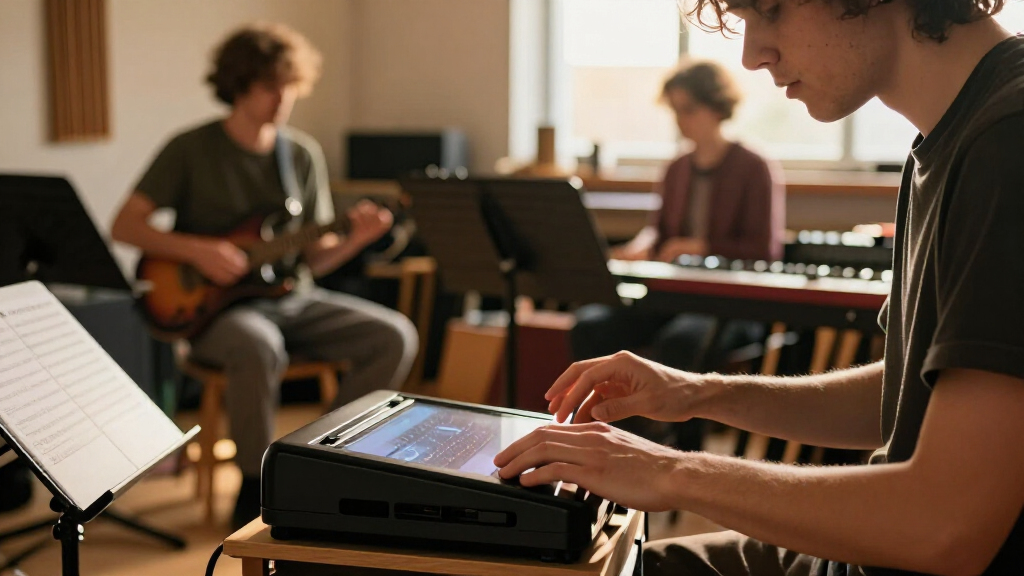
The project builds on CymaSpace’s existing work, including GestoLumina, a wearable interface designed to let Deaf and hard-of-hearing musicians engage with music through gesture, haptic feedback and light. The device was presented at the 2024 New Interfaces for Musical Expression conference. Project partners include Oregon State University’s OPEnS Lab, Eastern Washington University, Columbia Regional Inclusive Services and Telegraph Mastering.
Testing Music-Focused Implant Settings
The project addresses a distinction identified by its researchers: cochlear implant signal-processing strategies have largely been developed around speech intelligibility, while many implant users find music difficult to perceive. CymaSpace’s study will examine whether programming directed at music, paired with multisensory listening approaches, can support music engagement and learning. The source report does not provide results; the work is a study, not evidence that a particular setting has already improved outcomes.
For schools, the classroom pilot may offer information on how to make music education more accessible to Deaf and hard-of-hearing students. The intended curriculum links the laboratory research with lesson design, while the album and sensory tools give the team materials to use and evaluate. The project’s relevance will depend on what the study finds and how its curriculum is developed and tested.
cochlear implant music programming
As an affiliate, we earn on qualifying purchases.
As an affiliate, we earn on qualifying purchases.
CymaSpace’s Accessible Music Work
CymaSpace is a Deaf-led arts and cultural nonprofit based in Portland, Oregon. The Universal Music Design project extends its prior accessibility work, including the #deafjazz initiative, which explored ways to make jazz concerts accessible to Deaf and hard-of-hearing audiences. The current effort brings music technology research together with school-based education.
The research team includes project director Dr. Shawn Trail, an audio engineering faculty member at the University of Arizona; lead design engineer Dillon Simeone, who is Deaf; and Misty Jones Simpson, an associate professor at Middle Tennessee State University who uses bilateral cochlear implants. An advisory board includes researchers from OHSU, Oregon State University, Gallaudet University and Eastern Washington University. These roles and partnerships are described in the source report; the full study protocol and participant numbers are not specified there.
“Cochlear implants are currently built and tuned for speech, not music. This project asks what changes when we design specifically for music instead.”
— Dr. Shawn Trail, Universal Music Design project director
multisensory listening devices for deaf
As an affiliate, we earn on qualifying purchases.
As an affiliate, we earn on qualifying purchases.
Study Timeline and Results Pending
The source report does not give the project’s start or completion dates, the number or ages of students who will take part, or the detailed methods for comparing implant settings. It also does not specify when findings or the curriculum will be released. The $90,000 grant supports the project, but the available material does not break down how the funding will be allocated.
No outcomes have been reported: the work is described as a year-long study and classroom pilot. It remains unclear what changes, if any, the research will recommend for cochlear implant programming or which teaching approaches will be included in the finished curriculum.
accessible music education tools for deaf students
As an affiliate, we earn on qualifying purchases.
As an affiliate, we earn on qualifying purchases.
Research and Classroom Pilots Ahead
The project’s next steps are the lab work on music-oriented cochlear implant programming and multisensory listening, alongside classroom lesson pilots with students participating through Columbia Regional Inclusive Services. The team plans to use findings from both parts to shape a K-12 STEAM curriculum.
The source report also refers to NEA-supported public workshops and community demonstrations, but does not provide dates or locations. Further details about the study schedule, participation and release of results have not been specified.
haptic feedback musical instruments for deaf
As an affiliate, we earn on qualifying purchases.
As an affiliate, we earn on qualifying purchases.
Key Questions
What is the NEA grant funding?
The $90,000 grant supports CymaSpace’s year-long Universal Music Design study, including research on music-focused cochlear implant programming, multisensory listening and classroom lesson pilots.
Who is the project intended to serve?
The planned curriculum and classroom lessons are intended for Deaf and hard-of-hearing K-12 students. Students will participate in the classroom pilot through Columbia Regional Inclusive Services, according to the source report.
Does the project show that music-focused implant settings work?
No results are reported yet. The study will examine programming directed at music perception; whether any approach improves listening or learning remains to be determined.
When will the study results be available?
The project is described as year-long, but the report does not state its start date, completion date or when results will be published. No release schedule is specified.
Source: rss
Fall Picks
fall essentials
As an affiliate, we earn on qualifying purchases.